
School is in: The Cast & Crew of ‘Starfleet Academy’ Talk About the Important Lessons Trek Can Teach Us
Star Trek, like so many popular properties today, has become a divisive topic of discussion between the old and new guard. But fighting over what real Trek is might be missing the point entirely. ‘Star Trek: Starfleet Academy’ reminds us of that.
Aside from this occasional entertainment journalism gig, being a high school teacher for the last 17 years has taught me quite a lot about the youth of today. One of the most important lessons learned of late is that many of them are disillusioned with the world older generations have forged. Is that something new for teenagers? Perhaps not, but we’re now talking about teens who have lived through a global pandemic, at least part of an American administration that promises division and destruction at every turn, and a future that is more in question than perhaps even their great grandparents had to put up with a century ago.
Star Trek: Starfleet Academy perhaps represents and addresses that uncertainty better than any Star Trek show put on the screen thus far. Following the events of Discovery, the Academy is opened for the first time since ‘The Burn’, a galactic event that saw warp drives explode across the known universe, leaving the Federation and almost every known empire tattered. It represented a scary, unknown era in Trek. While diplomacy has always been a cornerstone of Star Trek, it is needed now more than ever, as old alliances are dead, and former allies are jaded opposition.
The first two episodes remind us of one of the key values that perhaps new Trek has forgotten. Ever since executive producer and showrunner Alex Kurtzman and his partners got their hands on the property, Star Trek has been more akin to Star Wars, as Kurtzman, Roberto Orci and JJ Abrams wanted to give audiences a little more literal bang for their buck. Yet it seems now is a time where Trek is returning to one of their fundamental characteristics.
“Star Trek was founded during the turbulent 60s at a moment of real cultural and political turmoil. And I think that at times when you have that same critical amount of cultural and political turmoil, the world needs Star Trek more than ever”
Co-showrunner Noga Landau mirrors that message of hope. “I think people have been waiting for decades to be able to see what it's like to be a cadet” Landau says. “There's so much wish fulfillment in the show, and it's also that you take the best and the brightest in the galaxy and you put them all on one ship.”
For many, such as this writer, it’s an opportunity to return to the teenaged adventure once had. A chance to try to jump into the proverbial skin of the age group I now teach. When The Next Generation was released, I was only 13 when the show wrapped its final season. Landau promises an injection of teenaged angst that could perhaps make everyone feel young again. “There's rivalries, there's competition, there's crushes, everybody's figuring themselves out, and part of figuring yourself out is stumbling, making mistakes, and doing things you regret, but you learn from it all. That's the fun of it.”
Check out the full interview with Robert Picardo, Tig Notaro, Alex Kurtzman and more by clicking below. Or continue scrolling for the remainder of the article.
Fun is something that many audiences in this jaded world have also forgotten, especially many Trek fans. While new Trek shows such as Strange New Worlds certainly revisits the bizarre and campy nature of the original series, and the fun loving-nature of TNG’s humor, there’s been a rift in Trek fans almost as if we had our own ‘Burn’. Some have forgotten the aforementioned youthful look on life that Landau wants to return to, and since they grew up with Trek, they’re only remembering what it means to them now, as adults, rather than why it was so intriguing as children.
When asked if this was his plan all along, Kurtzman admits he had no idea it would one day lead to Academy. “You have to let it breathe and evolve organically, because if you're not open to the surprises, then you're not open to the magic.” Kurtzman reveals. “For example, Patrick [Stewart] said he was never coming back to play Picard again. So we wouldn't have expected that that was going to be an option. But I can tell you that I think Starfleet Academy is, in a lot of ways, the sum total of everything that we've learned over all the films and all the different television shows. It feels like the best of all the lessons ended up in this show.”
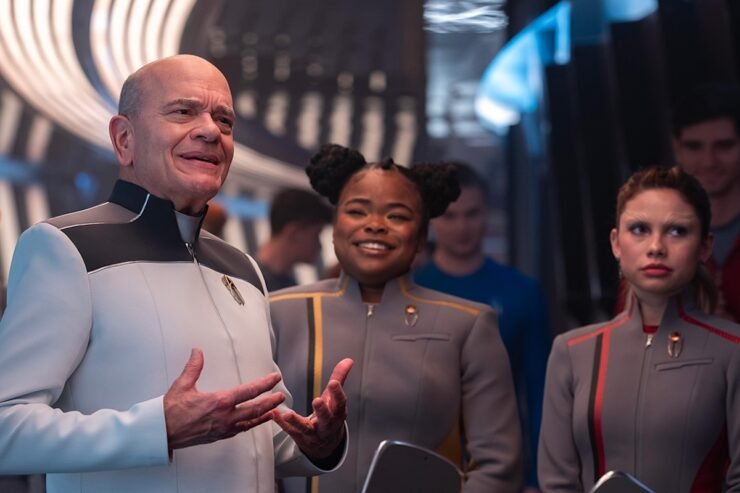
Someone who has been a part of Trek for even longer than the decade Kurtzman has helmed the property is the great Robert Picardo who starred as ‘The Doctor’ in Star Trek: Voyager. Voyager celebrated its 30th anniversary just last year. Being a part of the franchise for half the time it has existed has given Picardo unique insight as to why those jaded fans are perhaps losing sight of more than just their childlike sense of wonder.
Picardo sums up why he feels this is the perfect new show for the world we live in today. “Star Trek was founded during the turbulent 60s at a moment of real cultural and political turmoil. And I think that at times when you have that same critical amount of cultural and political turmoil, the world needs Star Trek more than ever.”
Picardo continues, addressing a word that is thrown around far too often from those perhaps too ignorant to truly understand its meaning: Woke. Many of those same jaded fans complain that the show has taken inclusion too far. That it focuses on the wrong things, perhaps forgetting that the show in the 60s, and every show since has been about a utopian future where inclusion was never a problem.
“I've heard some fans say that Star Trek has gone too far with its diversity and inclusion. I completely disagree with that.” Picardo tells us. “Why should our idea of diversity and inclusion in 2026 be the same as it was in 1966? 60 years later, we've all evolved. Humanity's evolved. The world's changed. So Star Trek is as diverse and inclusive as it has ever been, and as it should be. Science fiction dreams the dream, and then science fiction catches up with the dream. There's so many things in Star Trek that lead our imagination and posits a better future. I think that's what Starfleet Academy is all about… optimism for our future. What could be better for this moment in time?”
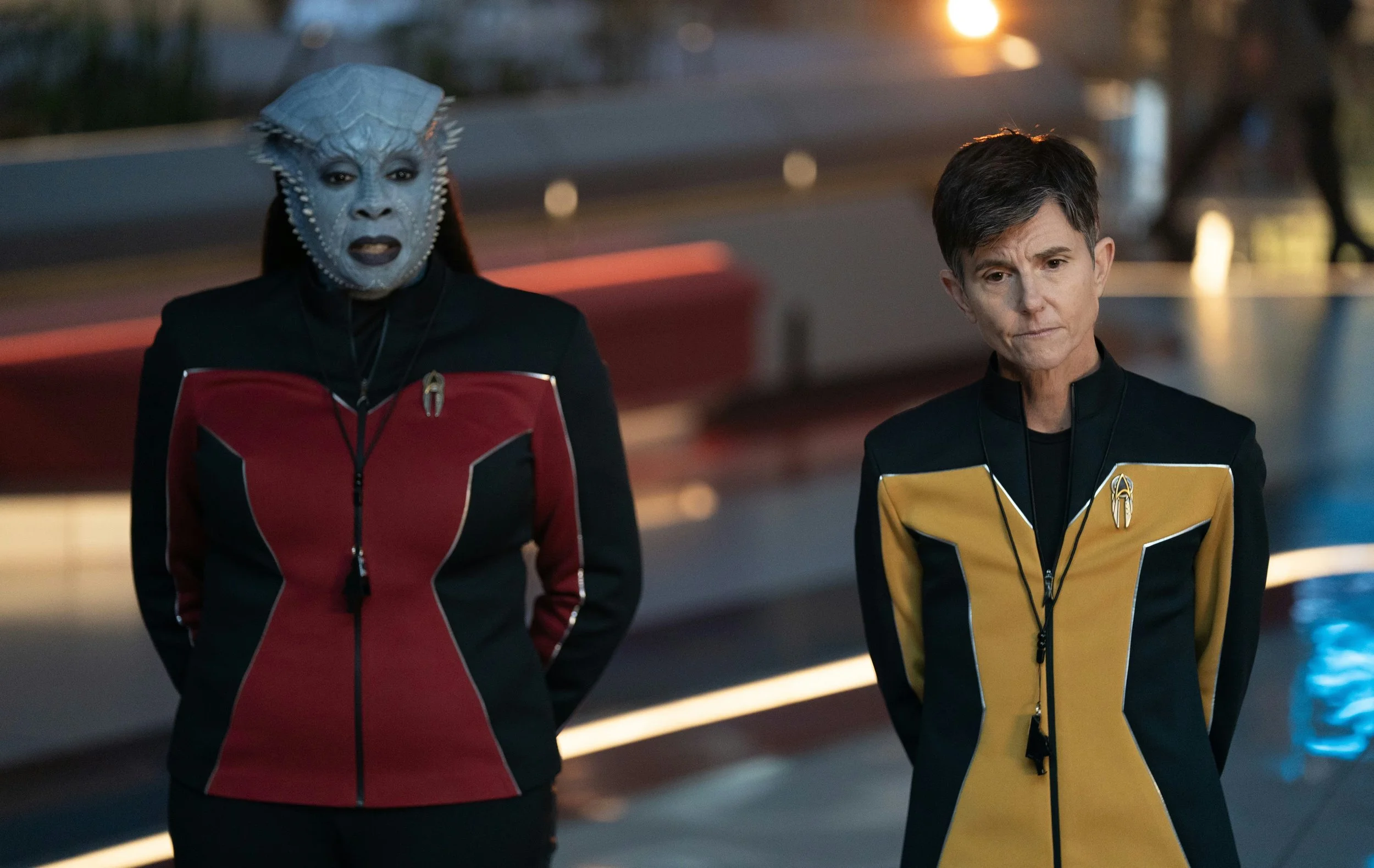
That inclusion gives Academy some exciting story threads and new characters to explore throughout the season. SAM, a ‘photonic’ is, like Picardo’s Doctor, a purely holographic character, and the first to enroll in Starfleet Academy. There’s also Gina Yashire’s Lura Thok, a half Klingon, half Jem‘Hadar, which prior to this program, was thought to be an impossibility by many. For Landau and Kurtzman, it’s merely another opportunity to boldly go where no one has gone before.
“It's such a fun mix between new species and familiar species,” says Landau. “I think my favorite was being able to really dig into a Klingon character. We haven't done that yet in the 32nd century, and being able to see not only this very unique Klingon in Jaiden, but also to catch up to what's going on with the Klingons. There's a whole story with them now that we were so excited to tell.”
Ultimately, that sense of fun and excitement is perhaps what has been missing for those burnt out fans, pun intended. Starfleet Academy offers a chance to recapture their youth and embrace some of those fulfilling experiences that made them a fan in the first place. In short, lose the teenaged angst, and grab hold of the hope that we were lucky enough to have as teenagers. A hope we’ve perhaps taken for granted.