
'Yaga' Showrunner Kat Sandler Discusses The Magic of Assembling of Her Highly Anticipated Mystery Drama
the accomplished playwright discusses adapting her play into one of the most anticipated shows of the year.
This renaissance era of Canadian television has been a truly wonderful thing for audiences of all sorts. While us Canadians know that we’ve always produced great TV, seldom have our greatest shows been globally popular sensations, something that has changed drastically in the last decade, and only shows signs of rapid acceleration. Of course, it would be impossible not to look at this broader topic without mentioning the meteoric success of Heated Rivalry, which radically took the entire world by storm, and firmly cemented a new star in Hudson Williams. It seems that Williams’ fanbase has followed him to his next project, YAGA, from accomplished playwright Kat Sandler, who adapts her 2019 play of the same name into a genre-bending limited series. It’s only fitting that this radical new era of Canadian television continues with an equally radical project in YAGA, which smartly remixes a series of mystery genre trappings into a socially articulate, steamy and engaging mystery with a great amount of fun to be had, emerging as a refreshingly irreverent new entry into a tried and true genre. In a recent interview with FilmSpeak, Sandler divulged her creative processes on the show, tackling its many tones, and reflecting on what it means to have such a personal story be at the forefront of the nation’s most exciting television era.
As mentioned, YAGA originated as a play of Sandler’s, the book of which has seen a dramatic hike in sales since the star-studded adaptation was announced. Sandler discussed her methodology in adapting the play in the structure of a 30 minute drama.
Kat Sandler: Well, the play lends itself really well to an adaptation, I think, but the big reason that that happened was because, Mackenzie McDonald, our executive producer, and one of my very best friends. During the pandemic, she was asked by Bell and Crave if she had anything that could fit into the 30 minute drama category, and she had seen the play in 2019. I've always been accused of writing very cinematically anyway, and so when [Mackenzie] asked, ‘Do you think that this could work as a half hour?’, and I said, no, absolutely not, it needs to be an hour. Then, when, thinking a little bit more about it, it did actually made a ton of sense as a half hour. It just meant that [the executives] really liked the play, which was about 2 hours long, and so, I was totally for the 8 episodes. It meant that the mystery and the story just got to be told even more compulsively, like with what we got to cram even more into these episodes. [Eight episodes] actually ended up making a lot of sense. I'm a half hour convert. I was in post, looking at the runtimes, and often being like, okay, we haven't used these 2 minutes, what can we what can we fill it with? It's so different to have the opportunity to expand a world into into television and to not use all the time. How could we use all of it?
There's quite a lot that is lifted directly from the play, including the voiceover that starts at the beginning, which began as these really witchy monologues in the play. When you adapt something, you want to keep the things that make it special, and it's very fun to have a detective noir narrated by Baba Yaga herself, rather than than the detective, because we spend so much time with them anyway. I think people who have read the play are gonna be excited to see a lot of the stuff that's still in there in the show, and then there's a bunch of surprises, even if you have read the play.
Click below for the full, in-depth video interview, or continue scrolling for the remainder of the article:
FilmSpeak: Right. You talked a little bit about how the show has so many different elements at play. This show feels very refreshingly irreverent with all of these classical elements, like the classic coastal village mystery, with some salient gender politics in it, while also just having a generally lighter tone. I'm wondering what the tonal process was like for you on this show that oscillates between so many different genres and ideas?
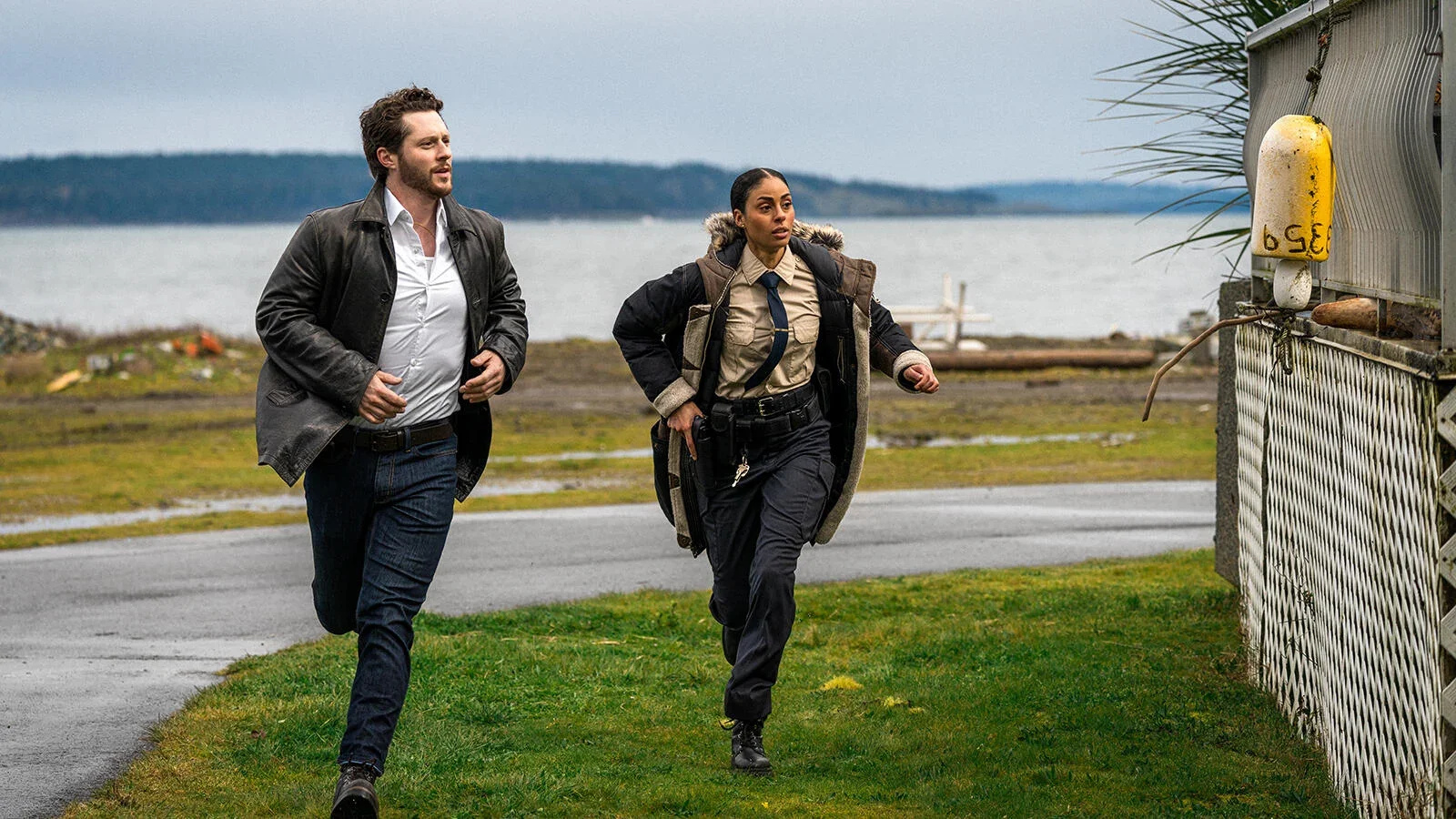
KS: A lot of that is in the play itself. It really is an homage to so many things that kind of taught me how to start learning how to be a storyteller, and things I grew up with. You're getting the Lynchian, Twin Peaks vibe of the town, you're getting the gritty detective drama, while you're getting a little bit of the buddy cop stuff. You're getting a lot of rom-com, and you're getting a ton of the theatrical banter that I love to write. It's kind of sexy and funny, and the irreverence, I think that's one of my very favourite parts of the show. It's just not a show that takes itself too, too seriously, and there's elements of camp. When we mention John Wick, like, we understand [YAGA] is a show that's aware that John Wick also uses the phrase Baba Yaga, and I think that's very, very fun. I think audiences are so aware of what's in the zeitgeist, and they're watching so much, and they have access to so much incredible story, and I think it's really useful to acknowledge that, so then everyone gets to be in on the joke, and the shifting tones. I think we're in this really cool time, where you can look at Widow’s Bay, and that idea of, like, cozy horror, which are not two words that you ever would have assumed would go well together. There’s also this kind of darkly comic feminine rage, and that is what Yaga is. As for the balancing of it all, I think it's mostly that I was always encouraged by everyone working on the show to push the tone bolder, to have fun and put as much of myself and what I like to write in the show. But, a lot of it is trial and error, and I'm sure there are moments in the show where it's not as balanced as we'd want it to be, but it is just letting those things exist together. I think with genre, you get a lot of mileage to talk about bigger issues, like as you mentioned, gender politics, which become a really big part of the show. Famous genre works like Obsession or Get Out get to talk about these much bigger issues under the guise of genre, using a story that feels a little more surface to get there, and, that’s something I really related to.