The Social Evolution: Comparing Aaron Sorkin's Cinematic Critiques of Facebook
the acclaimed screenwriter retackles the ethical dillemas around facebook, this time from a more broad perspective, and to varying results

Few screenwriters in the grand pantheon of cinema have remained as prolific as Aaron Sorkin. It’s rare for a screenwriter to enter ‘household name’ adjacent territory, especially in contrast to their acting and directing counterparts, but if anyone comes close, it would certainly be Sorkin. For more than thirty years, audiences have resonated with his punchy, mile-a-minute dialogue, and his exploration of contemporary topics ranging from politics to technology. Not to discredit the huge successes of The West Wing, but many would say that Sorkin’s ostensible ‘prime’ came from his return to feature films, scripting a trio of biopic films pertaining relatively recent events, released during the 2010’s. Sorkin’s sharp dialogue and rich thematics made for the perfect match with more incisive and daring filmmakers, like Danny Boyle on Steve Jobs, Bennett Miller on Moneyball, and of course, David Fincher on The Social Network, which is often hailed as one of the century’s greatest screenplays.
What has kept the Facebook origin story so relevant is not the fact that the platform/ conglomerate still loom large in our digital age, but rather its focus on getting to the heart of what makes Mark Zuckerberg, and on a larger scale, Facebook, so dangerous. The Social Network very carefully walked the tonal tightrope of having something incisive to say, while also reveling in the standard biopic rhythms. This is truly a difficult feat, given that the entire script is focalized around Jesse Eisenberg as Zuckerberg. There has been no shortage of rightful praise for Eisenberg’s performance as the controversial tech mogul in his earlier days. Mere days removed from the horrifying headlines out of Cornell University, The Social Network’s portrayal of how the ivy-league cultures is eerily relevant. The film recognizes these spaces as breeding grounds for toxic and predatory masculinity, which gets systemically weaponized. Specifically, the film is not afraid to show how these spaces and those in them informed social media’s dark impetus, rooted in female objectification and intentional discord, the latter of which becomes a more salient focus in the eventual ‘companion piece',’ The Social Reckoning. In lesser hands than Fincher and Sorkin, the film could have played far more traditionally, more interested in the aesthetics and frivolities of the media conglomerate’s meteoric rise. Fincher’s film is non-linear, but every scene, despite timeline, is in direct conversation with the next, both literally and thematically, in such a singular way.
With such widespread appeal for The Social Network, many doubts were cast when the news of The Social Reckoning broke. At the surface level, many were skeptical about revisiting such a singular piece in Network, especially without the sensibilities of David Fincher, and without Jesse Eisenberg reprising the Mark Zuckerberg role. Skepticism also emerged with the news that Sorkin was going to direct the film himself. While his solo outings have mostly fared well, critics and fans alike have recognized that Sorkin often works best with some kind of collaborative mediation.

By virtue of its title and director, The Social Reckoning is always going to be bound to comparison to The Social Network, with this very piece as evidence. Though, from the get go, the change of structure in Reckoning sets the tone that the two are entirely different pieces linked by the same core subject, Facebook and its broader cultural malpractices. For better or worse, Sorkin trades the laser sharp case study-esque feel of Network for a more broadly traditional journalism-based movie in Reckoning. All throughout, Social Reckoning plays it fairly safe, and is very much a conventional film, which often undercuts its attempt on clearly defining its stances on the key issue of how Facebook optimizes political polarization through willfully promoting algorithms intended to drive up outrage in favour of user interaction. This in of itself is a compelling and relevant central idea to bring to life, especially as the subject of an investigative film.
Jeremy Allen White stars as Jeff Horwitz, a tech-averse political journalist chasing a story on Facebook’s intentional polarization, and his search leads him to Facebook Ethics employee turned reluctant whistleblower, Frances Haugen (Mikey Madison). The two form a collaborative relationship, mounting a public opinion case against Facebook’s manipulative strategies, operating non-linearly within the narrative, doing so without any ambiguity or intrigue to be found. Though Horwitz and Haugen are real people who valiantly fought to expose the truths behind Facebook, their cinematic counterparts are, by Sorkin’s own admission, fictionalized composites, with creative and tonal liberties taken in their representation. This is a choice that works within the more conventional structure Sorkin chose for the film, but seldom works in terms of dramatic or even political impact. This leaves the film’s two talented lead actors out to dry, delivering comparatively cartoonish performances that often get bogged down with a myriad of ‘Sorkinisms,’ which I can best define as self-righteous dialogues, and/or the noxious overuse of metaphor becoming antithetical to a scene’s dramatic impact.
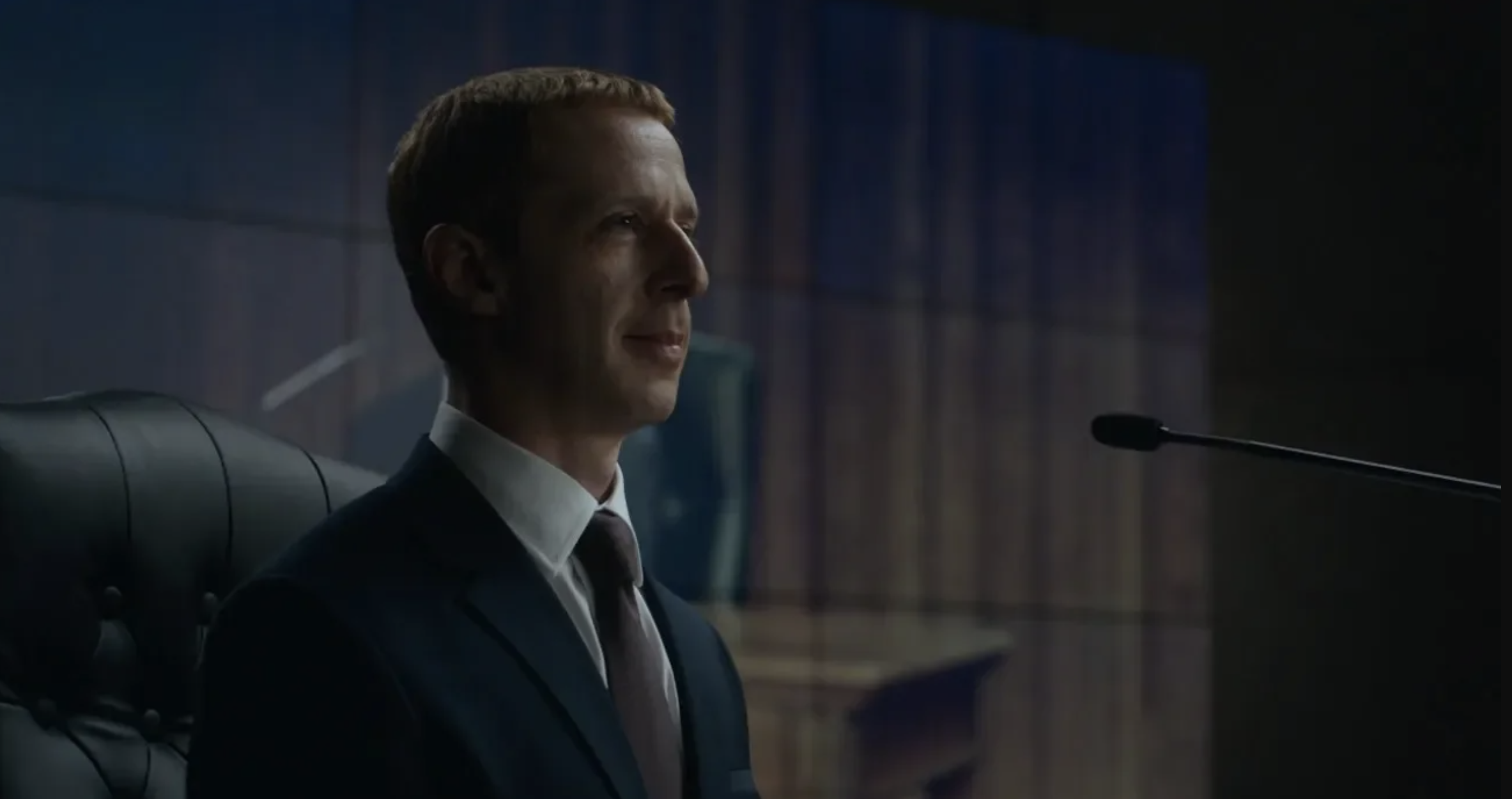
Jesse Eisenberg’s original take on Mark Zuckerberg, as mentioned, inhabited a very tangible sense of dramatic realism, drawing on Zuckerberg’s neurotic and off-kilter tendencies in real life, and using them to hone in on the more sociopathic elements of his life and actions. Jeremy Strong’s Zuckerberg in The Social Reckoning is far less complex, which is not the fault of Strong, a tremendously gifted performer stepping into a role that very much feels like a cul-de-sac within the contexts of Reckoning. Zuckerberg almost exclusively appears in a disparate subplot concerning his rehearsals prior to congressional testimony, in which a series of paid consultants try to prepare him for what his ‘interrogation’ will entail. However, very rarely does this framing device allow for much criticism or interrogation of Zuckerberg, who is very much posited as the film’s ‘big bad,’ and any traces of real stance beyond the obvious are effectively upended by creative choices in the third act.
This kind of toothlessness, so to speak, unfortunately reverberates throughout the film, becoming abundantly clear that Sorkin was more interested in The Social Reckoning as a ‘howcatchem’ pastiche exercise and vague ‘call to action’ against injustices that are very rarely shown to us, feeling dull and redundant, especially when it makes little attempt to engage with social media itself, both visually and systemically, in terms of greater narrative presence. This being said, the film also does very little reckoning with itself. For a film that espouses the dangers of political spectacle as content, its dramatic reenactments of real world political events end up feeling antithetical, and even reckless with the creative liberties taken in such reenactments. I can see why some of this would come off as disingenous criticism of the film, but I do feel my claims of the film’s political and thematic toothlessness are grounded in a sense of truth, with Sorkin himself admitting that The Social Reckoning is not a political film, a claim that fundamentally misunderstands the film’s own concepts, and frankly, cinema as a medium.
Is all this to say that the film is a complete misfire? Not necessarily, and it would be easy to imagine older or less-online audiences leaving the film with some minor learnings about Facebook’s immense and culturally dangerous powers, but at the same time, it’s hard to see any real resonance coming from the film, both culturally and thematically, which is a shame, given the great pedagogical and cinematic blend of prowess that The Social Network remains relevant for. Given Sorkin’s track record as a writer-director, it would have been naive for anyone to expect the level of incision that The Social Network operated with, but it is nonetheless disappointing to see just how much of a zero-sum game The Social Reckoning can be.