
'Conversation With The Sea' Interview: The Central Team Discuss Bringing Their Gripping New Thriller To Life
director muayad alayan, writer rami alayan, and lead actor kamel El basha discuss their layered mystery drama, family histories, and working around constraints
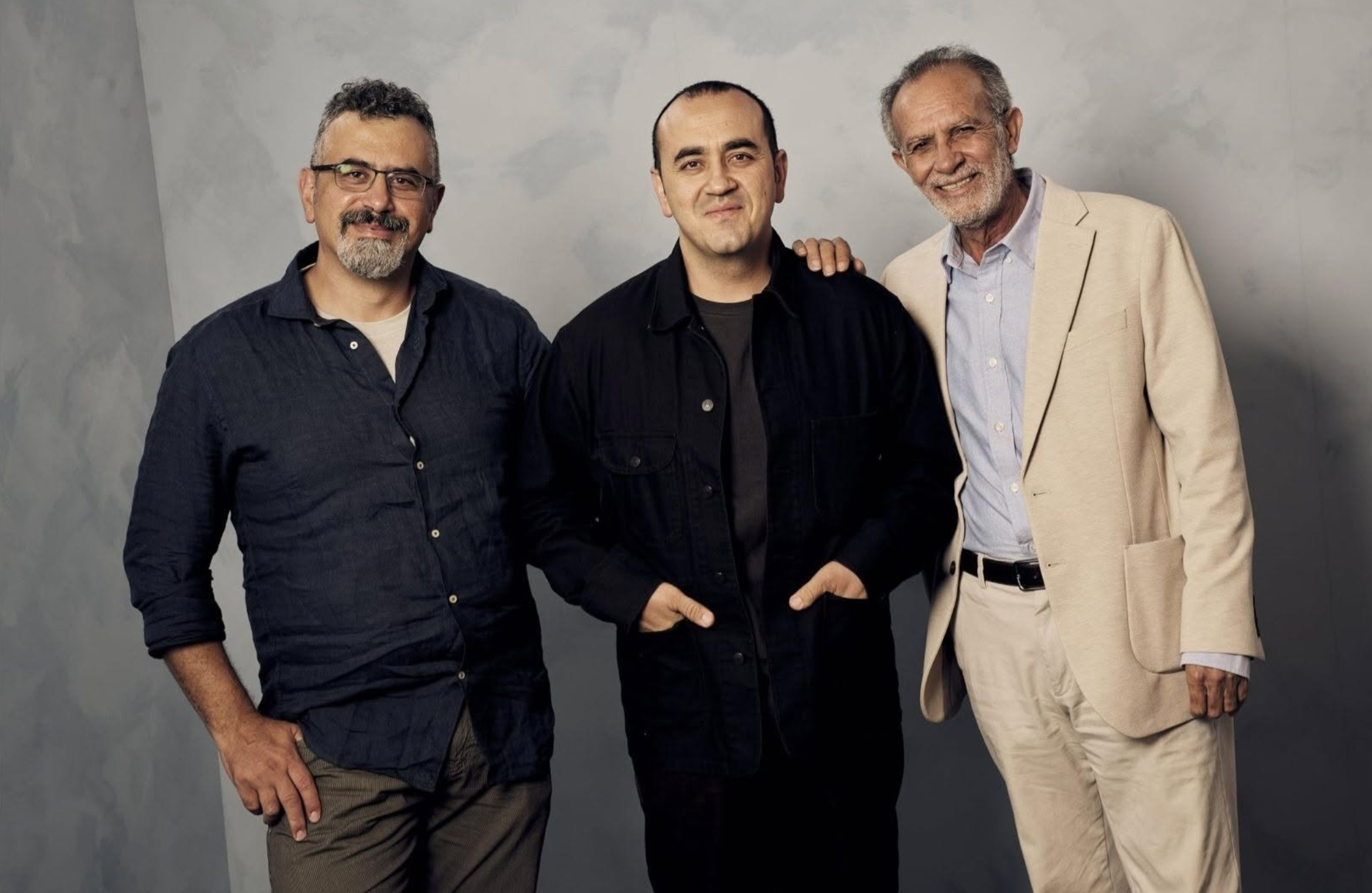
The rise of Palestinian cinema over the last few years has been an incredibly heartening thing to see, especially amidst the ongoing genocide plaguing the nation and its people. Several vital, informative, and harrowing documentaries cover the ongoing genocide, accented by a handful of stories using genre to tell stories of the Palestinian diaspora and their ongoing struggles of displacement—either literally or politically (ie; Mahdi Fleifel’s To A Land Unknown). Conversation With The Sea, the latest film from director Muayad Alayan and writer Rami Alayan, fits into the latter category, telling the story of a complicated man, Kamal (Kamel El Basha), dealing with the financial debts of his late estranged son, whose death he tries to find answers for. This proves to be a narratively challenging ordeal, serving as a scathing critique of how disproportionately Palestinians are treated in Jerusalem (and in Israel at large), both in legal and societal contexts. Muayad Alayan’s fourth feature is a massively gripping mix between social-issue drama, mystery thriller, and character study of a man living with generations worth of guilt and secrets. The core team behind Conversation With The Sea sat down with FilmSpeak during TIFF to discuss the inception, collaboration, and guerrilla-style production of their film.
FilmSpeak: I was wondering what it was like to build the structure of this film, because it takes some mystery genre elements, but there's also so much character interwoven, and many political elements, pertaining to Jerusalem and so much more. How did you guys decide on a mystery element to tell this story of Kamal searching for his son while and also grappling with his past and present troubles?
Rami Alayan: The starting point was inspired by true events, so it kind of sets our initial points. We tried to stick to a certain level of realism in regards to what triggered the whole journey for the character, but later on… it was fictionalized, dramatized, to increase the challenges and the obstacles that he meets along the way, while also designed in a way to represent [Jerusalem] as a character. So, the plot is kind of divided psychologically for [Kamal], trying to investigate his past, on the inside, and then on the outside, he's encountering all these different characters, some who represent East Jerusalem, on the Palestine side, and some would represent West Jerusalem, and this journey kinds of brings him back to the personal. So, it was the interplay between the actual character and the city, with the systems of the city as the other character. The inciting incident of Kamal getting the court order, I mean, that happened for real, to the family of Muayad’s father-in-law. So, yes, that kind of became something the starting point for the story. There are parts that are fictionalized, but I would say mostly everything in the film is inspired from real life… including the ending scene, is tied to things that do happen, and have happened to people that we know.
Muayad Alayan: Basically, we knew that this was going to be sort of a road trip movie, with a big journey. Then, the setup of the court order kind of gave it a mystery from the get go, and the writing process was about figuring out, how do you carry all of these themes, and how do you reveal the mystery gradually?
FS: Right, and that's actually something I wanted to ask about for you, Kamel, as your character holds decades worth of sorrow and regret, and we slowly get to unravel parts of this past. Where did you start from in shaping this complicated character with such a storied past?
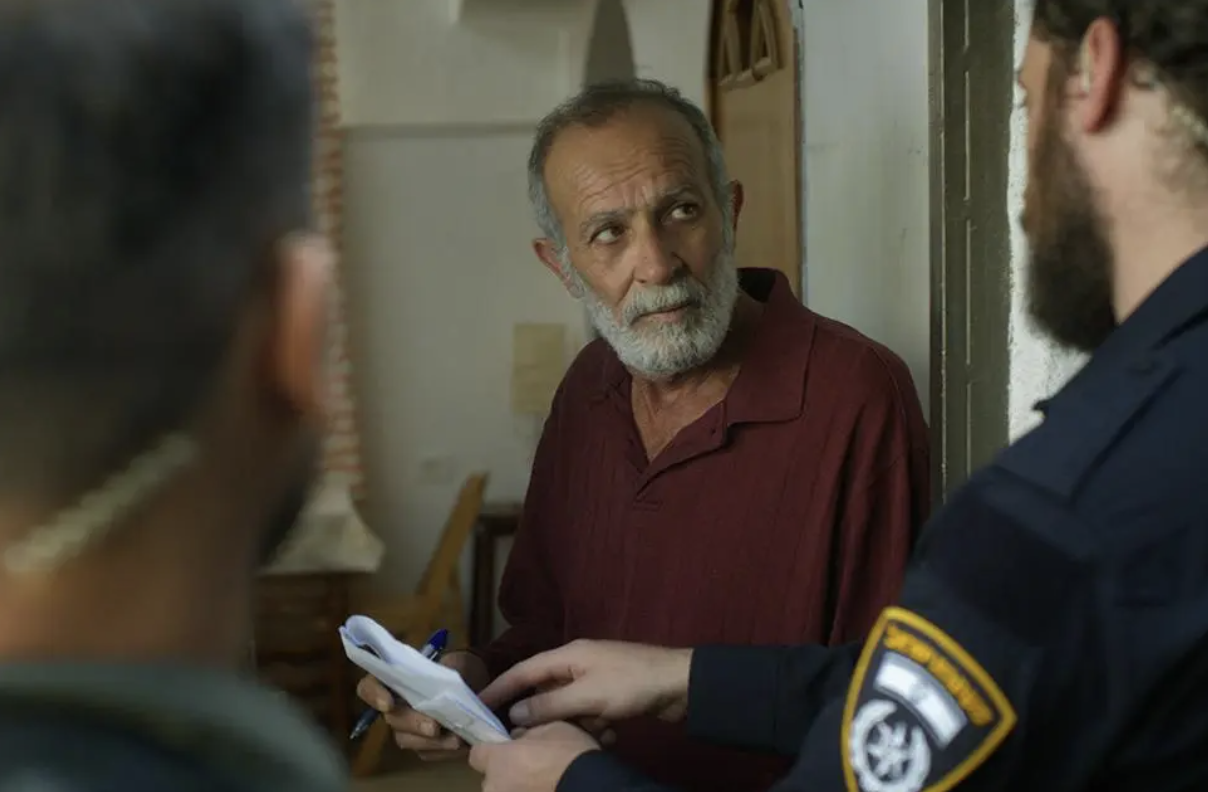
Kamel El Basha: Well, I think it was easy for me, because the character is very similar to of one of my uncles, who passed away in his 40s. He was a man of troubles, in a way. He had troubles with everyone; with his mother, his father, his brothers, sisters. Also, from another side, my grandfather was a baker, and he had a bakery in the old city. Jerusalem, I was born there. I have been living there all my life. So, it was not that difficult to create this character. Though I identify with the character, he must still be in service to be the director and the story. I did my best, and I hope that this character will bring hope to the hopeless. I hope so.
I mean, it's obvious, that Kamal is somebody you don't like at the beginning, and you slowly start discovering little bit of details from his past, leading you to either completely accepting, you know, the fact that he made these choices, he made these mistakes, and gradually discovering that he's human. He is not just an asshole who just wanted to destroy his family, he just lived within a system that is pushing everybody to the edge, you know? He tried to do the best he could, and it just destroyed him and his family, you know? That was a concern that for a good period of time in the beginning, you're just seeing this unlikeable character.
FS: I don't want to spoil too much about the ending, but I would love to talk about the thematics and many interpretations of it. It is such a trite thing to say that something in the film is ‘a character in of itself,’ but for you Muayad, I know you have talked about Jerusalem being kind of a character of itself in your works, but I feel very much that with this film, the sea is also, a character of itself. Pertaining to the title, I feel like this film almost feels like Kamal is having a one-sided conversation with the sea, but the sea also feels so full of thematic richness, we see it represent troubles, grief, and the ebbs and flows of life. I'm wondering what your thematic conversations about the portrayal of the sea were like, and how much interpretation do you're hoping audiences take from this part of the film?
MA: We actually had many conversations about this. We were discussing the symbolism of the sea, and how, in the beginning, there’s very straightforward symbolism. It is where [Kamal’s] son drowned. It's the sea that holds all the mystery, all the questions, it’s our black box, our mystery box, you know? In our discussions, Rami and I, we always try to convince one another of what ‘the right thing’ is, and we have to reach a consensus. There was a moment where I told Rami, ‘ You know what? Jerusalem is the sea’. With its depth, with its complexity, with its magic… everything that it carries and represents, it's another sea, in a way. Then of course, we have it representing the emotional, the internal conflict of the characters, and their quest for foreclosure with what happened. Kamal is dealing with his own emotions, about how he used to do things, and how he needs to do things differently, and sort of coming too closer with his past, so that is also a sea in of itself to navigate. There are many ways I see the sea in this film.
FS: Certainly. Speaking of navigating, I feel like another thing this film does very well is producing this very suffocating and claustrophic atmosphere in Jerusalem, especially as the lead character is working against a narrative clock. As we see in the film, it is a very hostile place towards Palestinians, and so I’m wondering what it was like to technically mount this production in such a space, while inhabiting its real complexities?
It's a whole different process from any regular production. I mean, there are regions in the world where you also have to be seamless, and you have to be compact, where you really need a lot of know how and, like, local knowledge to design a production. Figuring out where we could we get away with shooting some of these scenes was a real concern.
Each location had to be really well thought out, how many people, and also figuring out how we can get certain kinds of camera equipment to Location X, versus Y, versus Z. The production team was a large group of locals, but also with many European crew members, so we had to explain ‘the rules of the game’ within Jerusalem, and the geopolitics of the place. We had many main questions. Where do we feel comfortable? Where do we really have to shoot and run, and escape without getting in trouble?
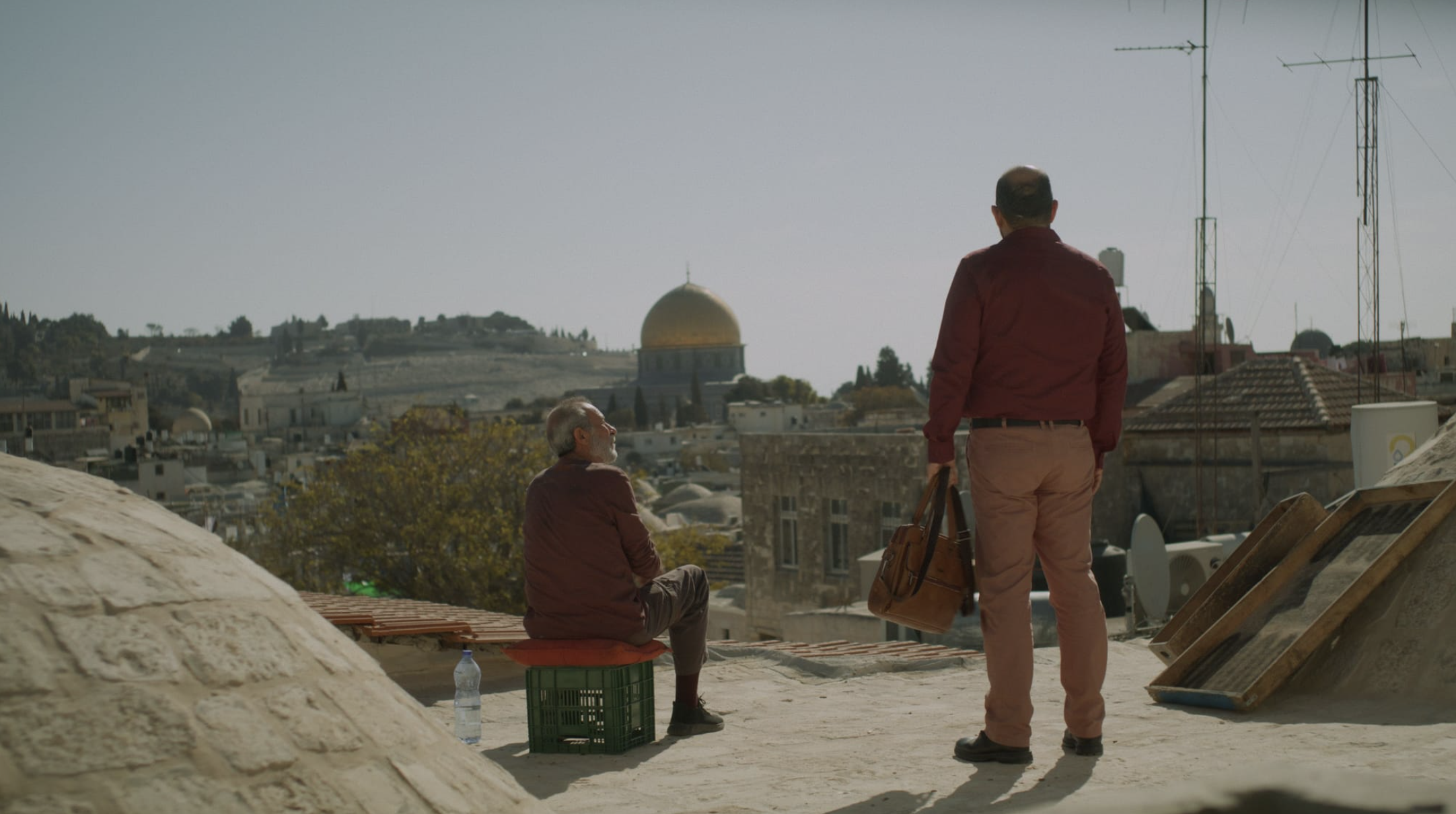
Generally speaking, we were shooting guerilla style on the exteriors. In the interiors, we were more comfortable. We could do whatever we wanted in terms of lighting, production, design, et cetera. In some scenes, we did a combination of minimal exteriors in both East and West Jerusalem. Then, in the West Bank, and in Palestinian territories, we had more access, more freedom to block streets, or to arrange shoots around certain locations and neighbourhoods. It was there where we did more complex stuff that needed more lighting, more blocking, et cetera.
FS: With that style, was there instances from the script that couldn't make it to the screen, or things that had to change because of these location challenges?
MA: No, because I'm really used to adapting, and letting the constraints of the place shape the story. I had an argument with the DOP about the scene in front of the wall, because he was really intimidated by the fact that the characters are just cornered in one place. We kept trying to move tables and to do other things, so it's more kind of standard, to the people’s usual lives. I just told him, listen, if the wall is what's imposing this on us, leave it. It's part of the reality of making this film, that this wall that's there, both story wise and literally. I embraced that, because it's part of the process, and I think it's it's also part of the DNA of the film. It gives the film this other dimension where it becomes a document of our life, of how we operated, of how we lived through the film.
RA: With Muayad’'s writing style, he decides the formula for the production first, and then he starts writing. I put the limitations first, and I know everybody says you shouldn’t do that, you know? That's why we have our contention sometimes. I know Jerusalem, and no production in right mind would film in the city. There is no production, not even Palestinian, or even American that would fully film in it. They would find alternatives in Malta, in Greece, and Cyprus, even maybe in northern historic Palestine, looking for an old city. You have to be crazy, or, you know, or very local, and you know how to get around to Jerusalem to be able to do it. I mean, we had to have fixers. Our fixers, basically, know systems from every neighbourhood. You need to have somebody from that community because there's a lot of anxiety and mistrust about, you know, our subjects and crew taking over their homes, so everybody really needs needs to trust who you are. Overall, I tend to write a bit more freely first, and then go back to the constraint. Not in the case of this movie, but for an example, I might say, I would have an ambulance in a scene. Then Muayad goes, “Where the hell are we going to find an ambulance?”. It then becomes about getting the story beats right, and then we can rewrite the ambulance out, focusing on just figuring out what we want to dramatically happen at a certain point in the story. With my experience shooting four or five films so far in Jerusalem, I would say that you need to choose your battles, in terms of which scenes are really worth fighting to make in a specific way. It's always not worth getting into the trouble of trying to something off, given everything around us, Israeli police, military, settlers, et cetera. No matter what, with these films, we're going to have to take the challenge. It should not be as risky as it currently is, but that is the reality. So yeah, you choose your battles, basically.