
‘The History of Concrete’ Review: John Wilson Documents Pure Humanity [Festival du Nouveau Cinéma 2026]
John Wilson uses concrete as the ultimate metaphor for humanity’s current predicament in the incredible ‘The History of Concrete.’

2026 will probably go down as the decade’s most thrilling year for documentaries. A genre usually dismissed by the public (and many critics) gets new life through the work of John Wilson and Nathan Fielder, who break the foundations that documentary filmmaking has been treading since the very conception of “non-fiction” film. While You Can See Everything is certainly (and deservedly) getting the most attention, one can’t ignore Wilson’s The History of Concrete, which just had its Québec premiere at the Festival du Nouveau Cinéma in Montreal.
If you think a documentary on concrete (you’ll quickly learn that it is much different than cement) might be the most mundane – and boring – subject for an almost two-hour-long feature, Wilson’s approach to educating the public on a material that’s a prevalent part of our everyday lives is as eclectic and psychotic as his flagship HBO show, How to With John Wilson. What starts out randomly didactic and educative quickly turns into a funny and often heartbreaking portrait of humanity’s current predicament, as he uses concrete to draw unwieldy parallels to the human figures he depicts.
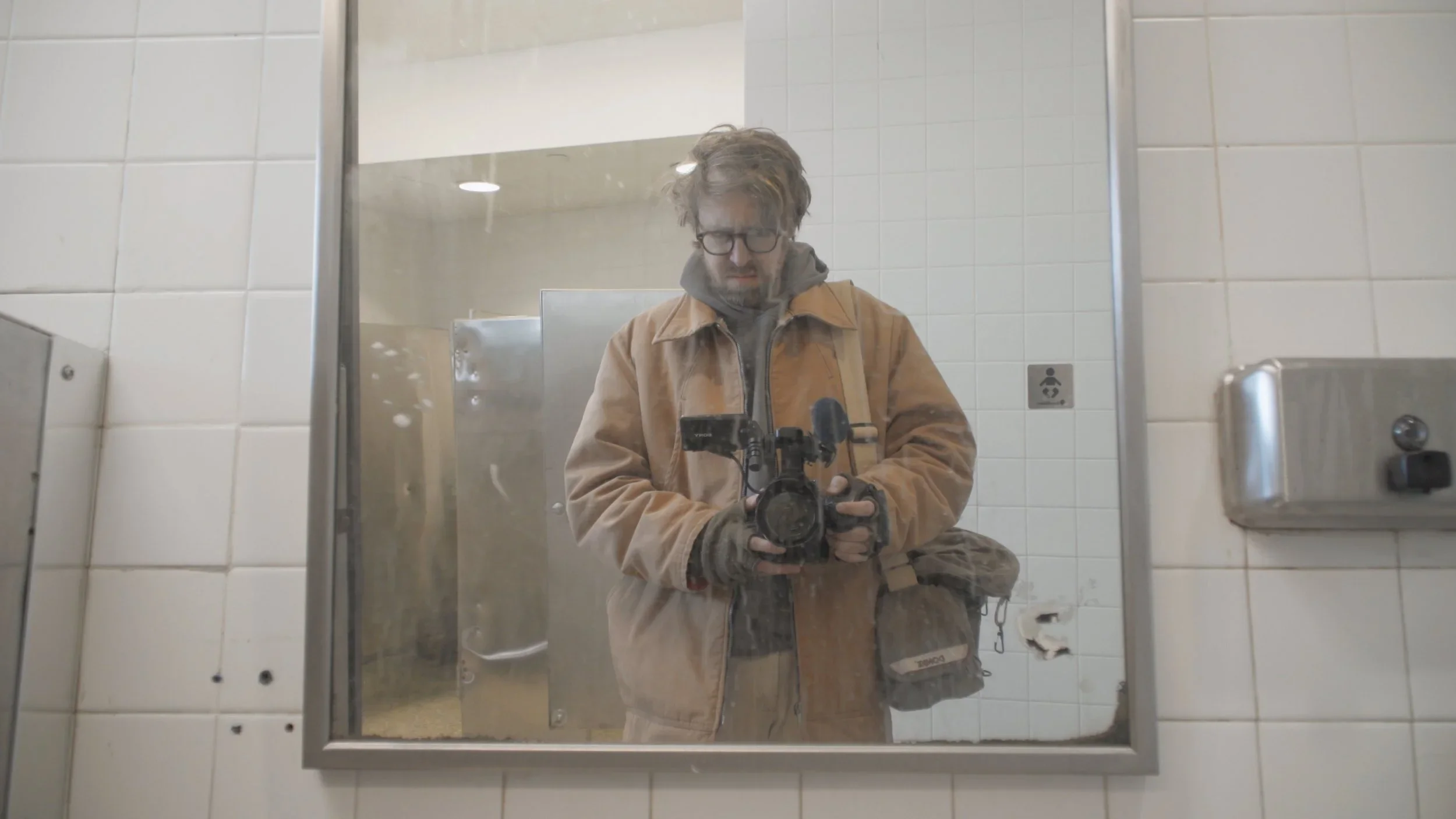
Wilson begins his documentary by trying to figure out what to talk about. He seems to have run out of ideas and spends most of his days trying to figure out what he could document during the 2023 WGA and SAG-AFTRA strikes, as most productions have shut down. The WGA still gave a seminar on the industry of Hallmark movies, and John covertly brings a DV camera into the meeting to record what is said. This scene – a perfect encapsulation of Wilson’s subjective (and fluid) filmmaking techniques – primes the audience that The History of Concrete won’t solely focus on its subject matter and has far more to say than it meets the eye.
It’s a movie that floats between the educational, informative essays Wilson is known for and a sharper, more perceptive edge. His examination of the history (and industry) of concrete is self-serious and often caustic, especially in how his camera depicts a parallel world that many Americans might not even know exists in their country, but his documentary begins to take a far more personal note as he approaches a scathing and heartbreaking conclusion that reframes everything we’ve seen beforehand.
Wilson doesn’t shy away from a freer form than audiences are used to in documentaries, and he begins his study of concrete by going to Italy to figure out why their concrete holds up so well when everything in the United States is falling apart. That question will serve him later when he excavates something much deeper than concrete, but his ability to mine such humanity by using his titular subject to explore his own country is probably the biggest stroke of genius since he started telling us how to. Anyone without a passing knowledge of Wilson’s filmmaking might feel discombobulated by The History of Concrete’s unexpected turns, but that’s exactly why the maddening, almost quick-witted approach to his documentaries makes each (handheld) frame feel so alive and exciting.
The way in which he incorporates different filmmaking formats keeps us on the edge of our seats. One scene shows Wilson secretly filming a GQ dinner honoring Kim Kardashian, where he is – for reasons unknown – invited. Throughout the scene, Wilson’s camera focuses on the figures giving speeches in tribute to Kardashian (perceptive viewers might notice Tom Ford, Jacob Elordi, and Cailee Spaeny) until the final moment, when he reveals who is sitting in front of him. That precise moment (a word I rarely use to describe anything, but is so apt for this particular film) is the year’s best. I won’t reveal who is sitting in front of Wilson, because even if I told you, you wouldn’t believe me. It’s exactly the type of observational filmmaking that Wilson breaks by showcasing how his simple visual language yields unexpectedly hilarious and moving engagement to the viewer.
Digressions like these might feel unimportant, but they are the primordial reason why The History of Concrete works so well. We understand the filmmaker’s headspace by showing us things he isn’t allowed to, which keeps us close to him whenever he interviews a subject and tries to understand the one material we'll encounter more often than not. He’s able to link the textures of concrete and cement to a 3100 mile race organized by the cult of Indian spiritual leader Sri Chinmoy, who challenges participants to run around in circles, from 6 am to midnight, for fifty-two days, so they can reach a form of spiritual fulfillment. Wilson doesn’t understand why anyone would do this, stating, “You could understand someone being suspicious of someone without a job walking in circles around a high school for two months.”
But he films the event because they are running on concrete, a surface participants describe as “unforgiving.” He then shows how “unforgiving” it is, from a logistical, structural, and, eventually, environmental perspective. That latter section might be the most scathing indictment of the Eric Adams administration captured in any movie I’ve seen, as Wilson illustrates the health impacts of Concrete Recycling Centers all over New York, as the pollution that it actively creates worsens the wellbeing of residents that live close by. Soot is formed quite easily, and lord knows what illnesses that will bring to them in the years to come as they are still dealing with the negative actions of a corrupt administration that has never fully been able to “get stuff done.”
The film’s most potent image comes when Wilson films Adams, unhappy, as he’s set to speak on a controversial zoning project that just got approved by the city, knowing the blowback it will create but still pretending the legislation being passed will help New Yorkers. He pinches both Adams and Governor Kathy Hochul with his fingers, as this image parallels Buddhist Monks who, with their sand drawings, showcase the impermanence and instability the world creates at almost every turn. It is always in perpetual movement and will never stop, for better or worse.
This leads to the movie’s final section, which many have dismissed as “overlong” or “unnecessary” when it is, in fact, the film’s most important. Without giving too much away, Wilson meets an aspiring rocker at a liquor store named Jack Mocca, who he will eventually learn was in a relationship with Dorothy Chin Brandt, New York State’s first female Asian American judge, best known for sentencing rapper DMX to prison. Everything in the movie is linked, one way or another. For instance, Wilson will interview Kyle Sherwood, co-founder of the company Save My Ink Forever, whose grandfather, “Mean Gene the Embalming Machine” (whatever that means), embalmed Chef Boyardee. That detail will be critical to understanding the significance of his final image, and how DMX’s presence in the movie becomes important when he meets Mocca, reeling from the loss of his fiancé.
By that point, one understands that The History of Concrete isn’t necessarily about its subject, but about how we, as humans, move through a world that never stops moving, whether it tumbles down and never picks itself back up. Once that clarifies, the film’s final shot – and line – might register as the year’s most soulful in a world that has lost all sense of meaning as it continues to shout at each other and pollute the planet both physically and psychologically. Maybe one should have a hard look at themselves and understand why life is “just lemonade” before trying to make sense of a society that will never make sense. Perhaps that should be the title of Wilson’s next project, but he doesn’t really know what he’ll talk about until he picks up the camera once more…