
‘Corpus’ Review: Corrin Evans’ Debut is a Strikingly Indecipherable Object [Fantasia 2026]
While not without its flaws, Corrin Evans strikes the screen with the aesthetically invigorating and thematically rich Corpus, one of the major highlights of this year’s Fantasia Cheval Noir section.
The Cheval Noir competition at the 30th edition of the Fantasia International Film Festival might have taken some time to get going, but we finally have a straight banger on our hands with Corrin Evans’ Corpus. While imperfect, it is the type of big swing we love to see at a genre film festival, where bold and fresh ideas are celebrated and championed, especially when a film goes in directions we don’t expect and brilliantly pays off what it has been patiently building throughout its runtime.
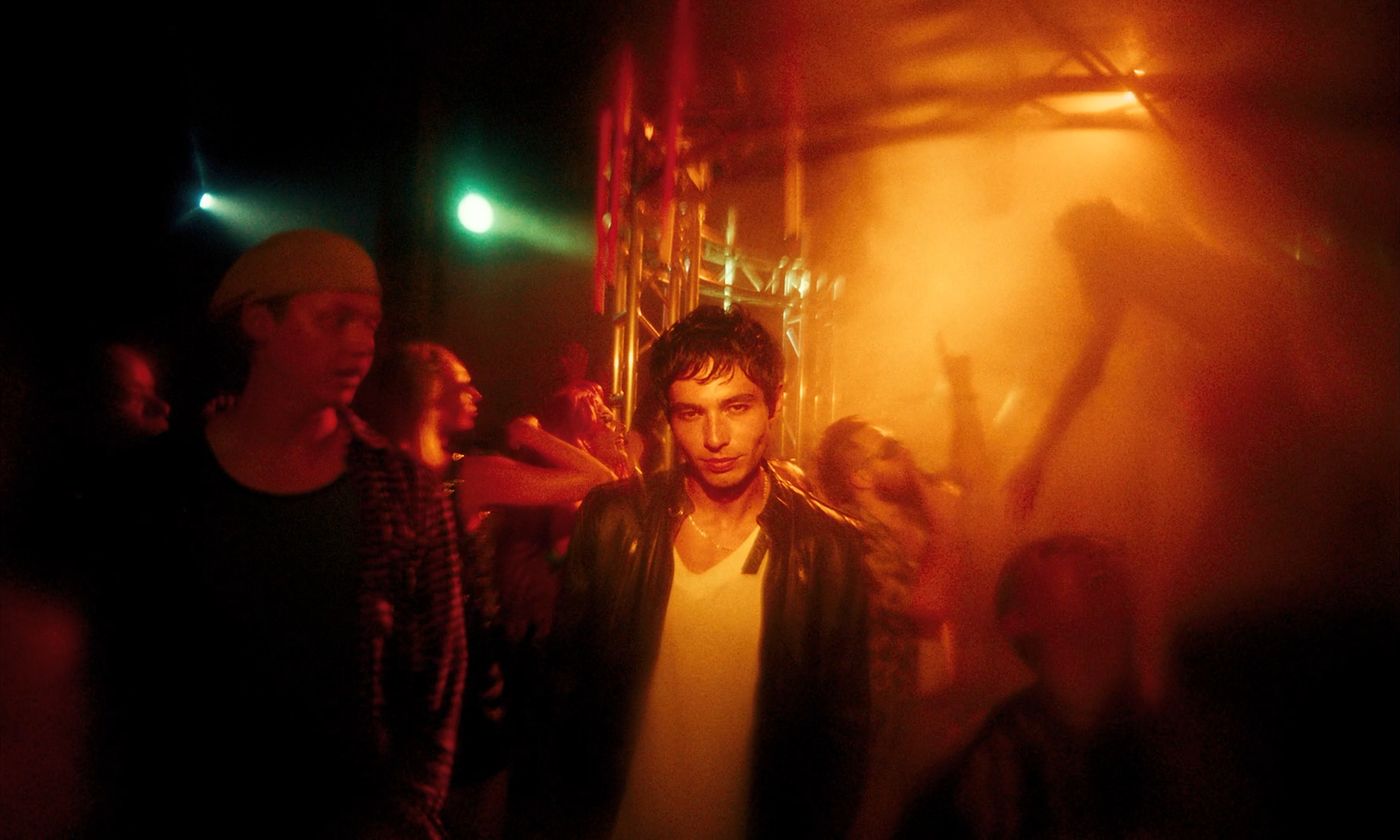
What seemingly starts out as a queer love story morphs into something else entirely by the time it reaches its shocking final scene, foreshadowed by an opening sequence set in 1997. Evans then cuts to a year later and completely forgoes that moment for a good chunk of the runtime while we are introduced to the protagonist, Sayo (Jeff Wahlberg). A photographer, we meet him inside a nightclub, as his flash distorts space and time. Beyond the opening credits sequence that puts us smack-bang into the grunge era of the 1990s music scene, Sayo’s flashes are the most striking images of Evans’ debut, immediately luring us into this indecipherable object before we even have a chance to know what this film is truly about.
In that moment, Sayo meets burgeoning movie star Vince Marlowe (Brodie Townsend), a figure he’s had a crush on for a long time. Even better, he gets invited to a party upstate and tags along for the ride, until he arrives at the household of three women, Billie (Lily Cowles, who also co-wrote the screenplay with Evans), Wren (Nuha Jes Izman), and Cata (Ching Valdes-Aran). Things are not what they seem, and that’s about as far as I’ll go in describing the plot. What I can say is that the opening scene, which many audience members will likely think is isolated, comes back to us in a big way and leaves the most indelible mark on the film’s second half, one that blurs the line between seduction and hunger in ways few have captured in a movie before.
Any preconception you had about where Corpus was heading as Sayo locks arms with Vince will be thrown out of the window as soon as Evans introduces a device that shifts the movie into completely unexpected – and supernatural – territories. The way that particular device is woven into the plot and helps us understand who these characters are, far more than any line of dialogue would, is genuinely unforgettable. It’s so intelligent that one wonders exactly why we had to spend a good amount of time in the film’s middle section in cyclical territories. With Evans speaking in interviews that sex in cinema shouldn’t be shied away from, there’s a point where the sex in the film becomes a little too excessive and slows the progression of the film’s thematic experience down.
That said, the way that she films bodies in motion is so instinctual, primal even, that it becomes one of the major highlights of Corpus, a film that seems more driven by the body than the mind. In fact, most of the characters’ actions come from the body, though the mind is clearly intertwined after a pivotal, dramatic turn evokes our darkest nightmares. Even when it doesn’t fully cohere, especially during a dinner scene whose line deliveries fall flatter than its striking, almost exaggerated color schemes, there’s something so alluring to see a debut that’s this committed to give audiences something they’ve never seen (or in this case, experienced) before that its inconsistencies act more as a feature than a bug.
Because the viewing experience of Corpus is far more sensory than it is visual. The sound design is intricate and electrifying. The photography continually floats between dreamlike visions of our idealized reality and the harsh nightmares of what is actually happening before our eyes. It’s unlike anything you’ll see this year, with images that are bound to stay with you long after you’ve lined up for your next Fantasia film. The performances are also quite compelling, with Wahlberg and Townsend being major highlights. One would be remiss not to talk about Michael Vlamis (who recently appeared in Christopher Nolan’s The Odyssey), who plays a supporting role whose actions near the film’s end have real dramatic heft. It’s a film that will devastate as much as it will stun you and perhaps reign supreme as the ultimate Cheval Noir picture of this year’s Fantasia.
With Corpus, Evans has undoubtedly announced herself as a major, significant talent, and one can hardly wait to see what she will do next. One thing is clear, though: after this world premiere at Fantasia, her career will never be the same.