
'Strong Son' Director Ian Bawa Discusses Emotional Responsibility, Memory, Masculinity, Personal Healing and More [TIFF 2026]
the acclaimed filmmaker discusses translating his shorts into his feature debut, a deeply personal portrait of a father-son relationship
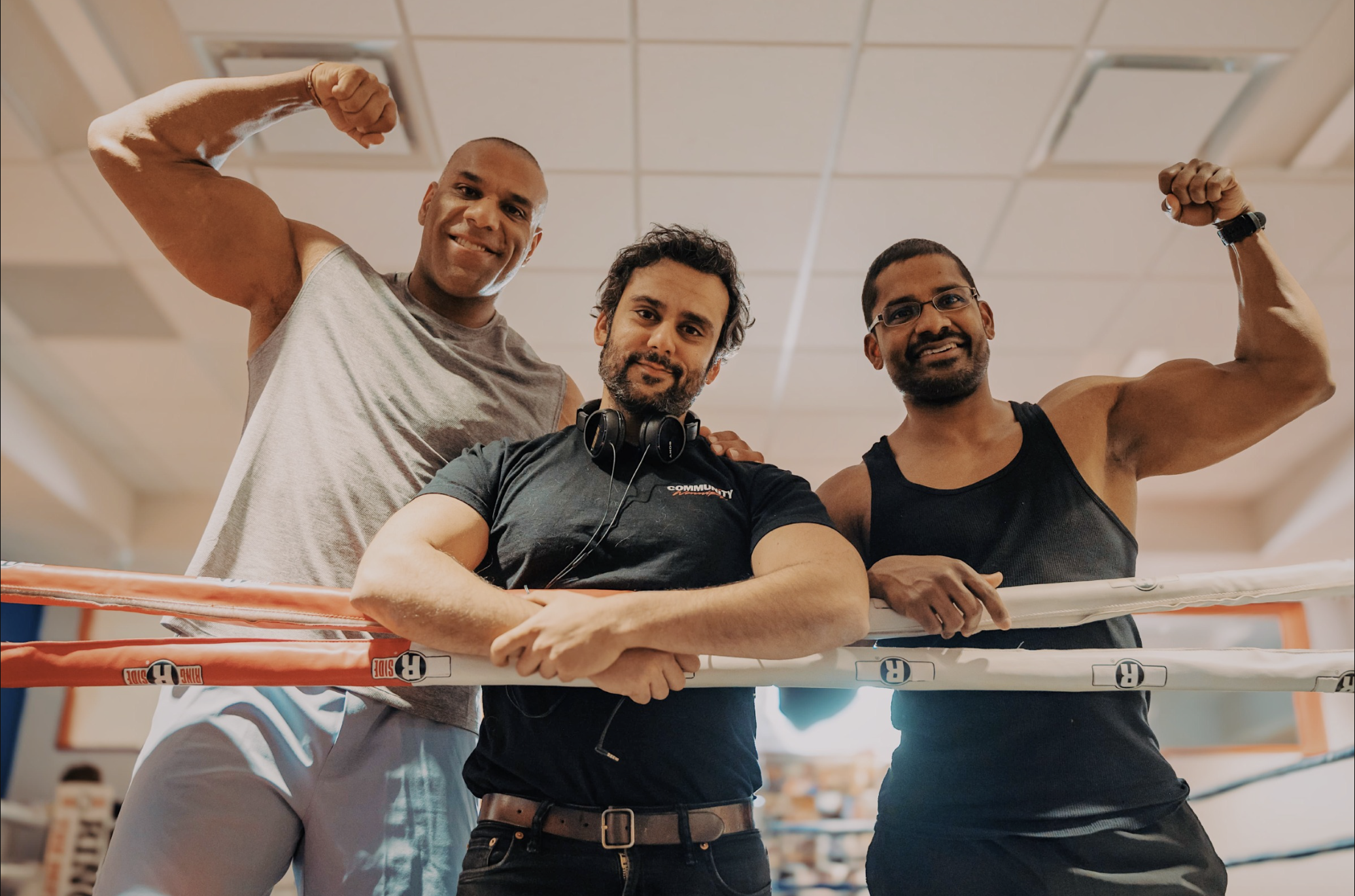
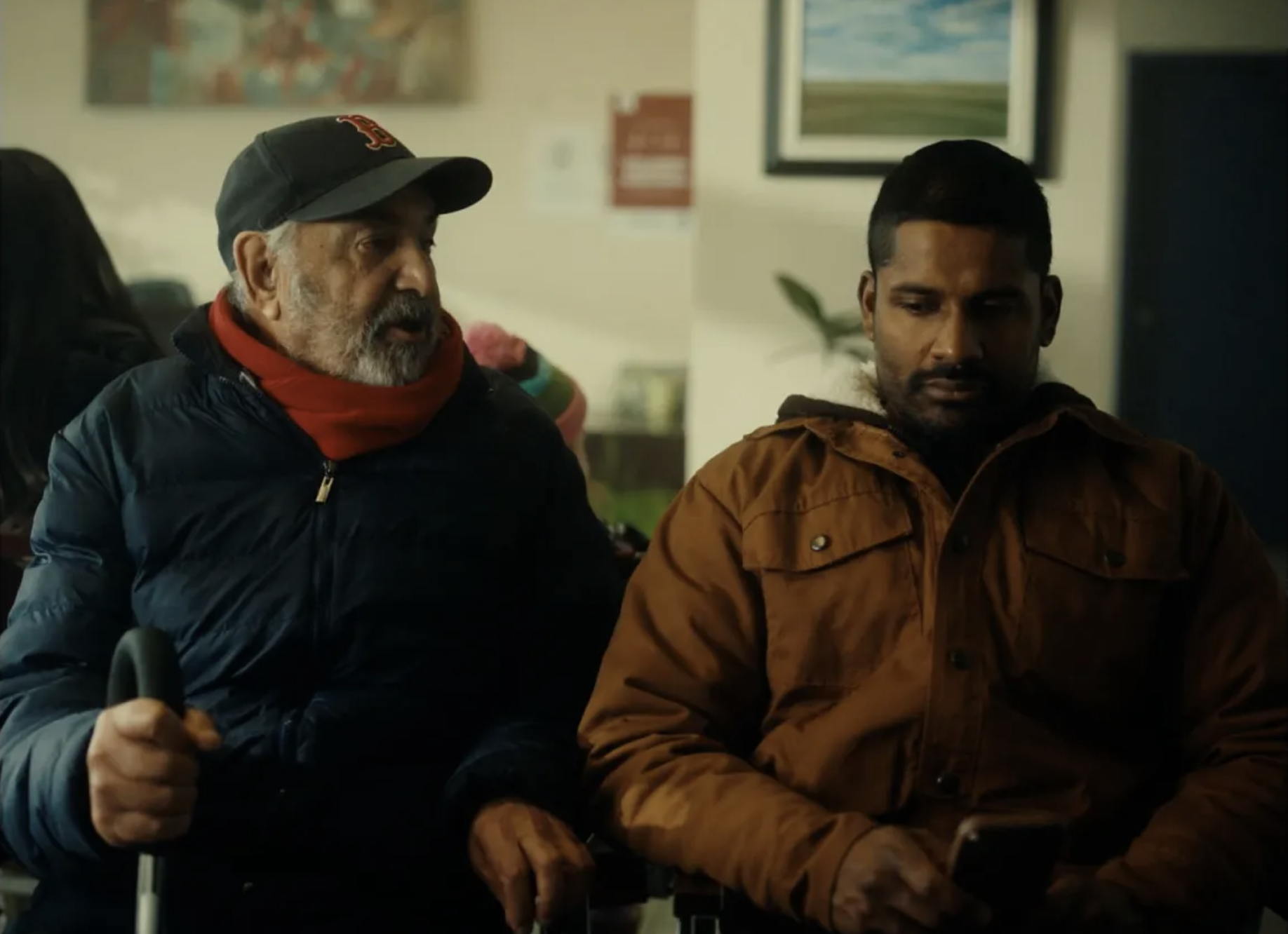
It has been an exciting few years for Winnipeg filmmakers. Contemporary Canadian directors like Matthew Rankin and Johnny Ma have embraced the eccentricity of the city through their films, to much acclaim. At this year’s TIFF, a new name joins the ranks of rising Winnipeg filmmakers, in Ian Bawa. Bawa, whose trilogy of short films garnered extensive acclaim during their festival circuits, makes his feature debut with Strong Son, the story of a Indian-Canadian bodybuilder named Harvinder, (often referred to as ‘Harvey’ during the film) who deals with his emotional issues amidst caring for his ailing father. While Strong Son may not inhabit the more stylized or even pronounced Winnipegs as some of the other films mentioned earlier, it is a distinctive film that very deftly handles themes of masculinity, image, memory, and family, and further cements Ian Bawa as one of Canada’s rising directors. Ahead of Strong Son’s premiere at TIFF 2026, Ian spoke with FilmSpeak about crafting a loving, empathetic, and semi-autobiographical portrait of the central father-son relationship.
FilmSpeak: First and foremost, I’d love to get into the genesis of Strong Son, and forgive me if this gets too personal, but I’m wondering what it was like adapting the short film(s) into the feature, especially after the passing of your own father. Especially with the father figure having such a big presence at like the core of the story, I’m wondering what was it like trying to adapt these ideas of yours in a new way, having that new experience?
Ian Bawa: Don't get me wrong, I've gotten used to talking about it and I have to talk about it. So, it's kind of part of the journey-slash-therapy. For one, the short was an accident. It was like one take of Super 8 footage that kind of blew up my life. Then when my dad passed away, before the short even got into TIFF. I think it was just after I made it, and I submitted it, I was just like, ‘what is the story behind these 2 characters?’. I kind of had ideas and started writing outlines, and then he passed away, and then honestly, I couldn't write. I just couldn't. In my head, it was like, asking myself, what is this story now that my dad's dead? What I did after that was two other shorts in the span of like a few years. One, specifically about grief and losing both my parents, and the other, uh, it was more of a sequel to Strong Son, called The Best. I also was thinking about the other side of the conversation and what is going on in this bodybuilder’s head while his dad's dead, and what is their real relationship? I say this because I think there's 2 sides of the story. The script itself became an amalgamation of these 3 short films, which I call the ‘Sad Dad Trilogy/ Series. If you watch all three, which is kind of fun to do, and then you watch the feature, you’ll go, wow, and really see everything I put into this. It's been kind of the process of just, like, really remembering my dad and legacy, because, honestly, when we go one day, all of us, it's like, who remembers us? It's our kids, and I don't have kids, but I always think, who remembers my dad besides me and my sisters, maybe? Like, their kids probably don't remember much of him. It's me. So this is me just allowing my dad to live forever.
FS: Yeah, and it's a beautiful tribute, and not just to a one-sided, idealized version that you have with somebody. Rather, it's a true multifaceted look at a relationship. That kind of segues me to my next question. I’d love to ask about the motif in this film of Harvinder breaking down and crying, because, I feel that in the hands of a lesser story, it may have felt more manipulative, coming off as, like, a narrative device or a gimmick, but instead it's like this very pure expression that breaks your heart every time just watching it.
IB: That's great. Thank you for that, because right now, we’re finishing up our sound mix, and we've been wondering, is this needing more to increase the energy? I said, no, it's supposed to be naturalistic, because it's so awkward to be in a room with someone crying, and I'll say, I'm that guy that's crying. I've had emotional issues like that. I can sense the other people feeling awkward, which makes me panic more. I think it was basically kind of what you just said, like, it's finding the sincerity of it, cecause, in some sense, I also think sincerity can lead to comedy. Like, this person is upset and is crying for so long that everyone's comfortable to go, wow, that's kind of funny. Like, it's it's so awkwardly uncomfortable that it's funny. That's entirely true of, say, The Office, and how they do things. So, I think for me, it was about not being over the top, and finding the right amount of ‘upsetness,’ I guess, or the emotion. I know the [lead] actor, Mandeep Sodhi, he’s my friend, and at first he was saying that it's just funny. Just naturally, when he was crying, and getting into that emotional state, his nose would run. That's just the thing for him. When some people cry, their nose runs. Some people eat spicy food, and they sweat. Everyone has it differently. When Mandeep’s nose starts running, it would be prized. It looked, way too much like comedy, and I was like, we gotta keep it with a sense of control.. You gotta make sure your nose is blown before we do these emotional beats, because there’s such a fine line of it being cheesy and over the top, with this guy's crying.
FS: It’s great to hear about how you create these organic scenes that aren't very set up to make us feel a certain way, but I think in the third act, there are some that really are, referring of course to the chest compression scenes. When we cut from the compressions to the visual metaphor of Harvey curling his father like a dumbell, that's a very powerful image. It's a very constructed image, but it really works. So I'm wondering, what was the process of shooting that scene, and did you have any notable responses from other people in the edit?
IB: In one of the ‘Sad Dad Series’ shorts, there is a scene very similar to it. Even though it was hard to do then, we had to do it again. In the short My Son Went Quiet, Jagdeep, the father character, dies. In [Strong Son], I always knew he was going to live… but yeah, no, it wasn't easy. As we were setting up to make the film, I had found an old box of all my dad's clothes that I was saving. I brought it for Amrit, (actor Amrit Parbhakar, who plays Jagdeep) and he's basically the same size as my dad, so he was wearing all my dad's clothes. He was in my dad's pyjamas, and it was very similar, I, like, found him and stuff, and he did all this, and I was like, and so, I was watching the monitor, and I don't know, I think, someone said ‘rolling,’ and then the AD said ‘action,’ and I just went into a panic attack. It was PTSD. It was something hard. Luckily, most of my crew were friends and people I knew. It was a very safe space, but it was still really hard. I remember, I sweated through my entire clothes in the matter of, like, the first two minutes of that take. I remember, because I drenched my entire shirt, the only other usable shirts that we had were my dad's old shirts. The voice you hear in this scene, both in My Son Went Quiet and the feature, Strong Son, the 911 call is my real 911 call. I have the audio of myself calling 911, when I had been doing chest compressions on my father, so all of that sound is real. So, I don't know, I think it's part of owning your trauma, owning your tragedy, trying to figure out my own therapy of things, but, uh, you also go, what's the point of having this if I'm not gonna use it for something greater? That's what I tried to do.
FS: That segues into something else I was going to ask with a personal film like this. What did it look like for you, going back to home base, wherever that may be, while you're shooting this? I ask because, when so much of the film is explicitly personal, and you're just, like, ripping it straight from your heart, what does it look like when you go home and try to reset? Is that a harder process, or are you're just happy to leave it all on the table at the end of a day?
IB: Mixed bag. I have a hard time turning off. I'm very much a workaholic, very hyper focused. I have a hard time sleeping, which is why I work out a lot. I run, I work out, and I just need to burn off energy to the point of exhaustion. It can be lead to problems, because you can hurt yourself by overdoing it, which is one thing I'm learning as I'm gotten older. Again, it's, I think it's a matter of finding the safe space, talking to people. I think half the time on set, it was me and my friend Marcus at the end of each shoot day, I would call him. He also was the director of photography. We have made all these movies together, and he is like my creative partner, and my best friend. I’d call him, and we just go through the day together. I think that was a way of deep decompression. I think I've also learnt that maybe it's healthy to separate the emotions and the art in a lot of ways, but in a lot of ways, it’s also not. When it does hit, it hits hard. We were on a twenty day shoot, and that isn’t a lot for a film. It wasn’t until we finished, and I got back home, when everything really started to hit me.
FS: You briefly alluded to working with your lead, Mandeep, who has the actual experience of being a bodybuilder. So much of this story is yours, but how much of his story made it into the film, especially with the body-building elements?
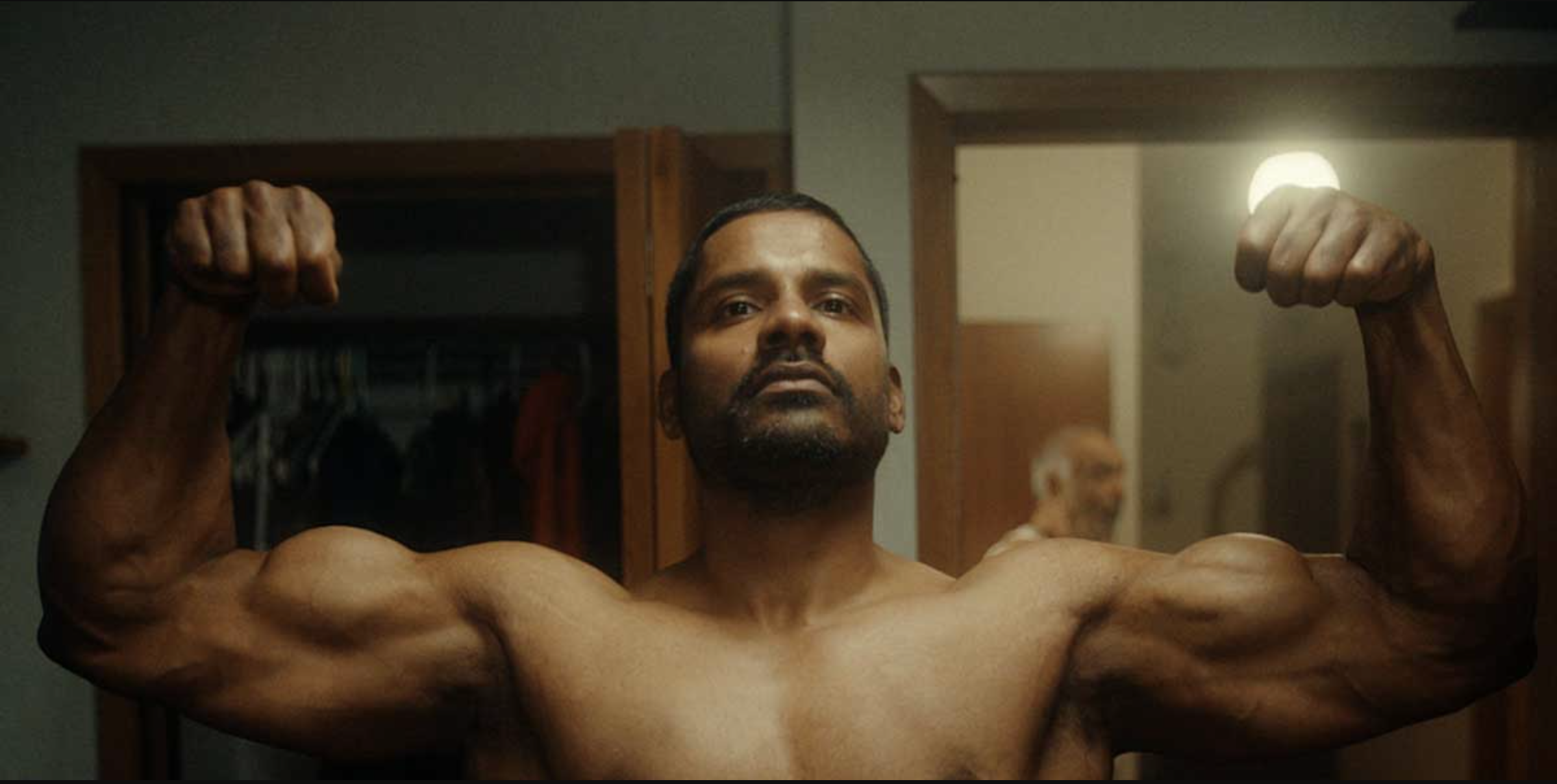
IB: He's been a friend for the last few years.I met him around 2019, before we shot the shorts, and he was a gaffer on a true-crime show I was directing. We got very comfortable with each other. I'd also joke with him saying… “my dad would love you, you should be my, you should be my dad’s son,” and I kept making that joke a lot, and there was some truth behind it. I think, for one, I purposely wrote the character to be a former bodybuilder. Harvinder, he’s just feeling good by working out and not really for the glory of winning, because bodybuilding's so strange, which is why the dream sequence in this film is of a bodybuilder doing exercises on stage, because when I'm at the gym, that's the thing I find interesting. I think Mandeep actually understood that aspect. He actually just competed like 3 months ago, and won a bunch of stuff and he's like, in his mid 40s. It's crazy.
FS: When you're conceiving of something like this, where you don't have the expertise and the knowledge of bodybuilding’s intricacies, does inspiration come from the ideas bout masculinity and strength?
IB: 100% about masculinity and strength. I was a very, obese kid growing up, I lost 60 pounds when I was in Grade 12, and so I, and became ‘pencil skinny’. Then, I started going to the gym, and when I started going to gym, I'd go to, like, take off my shirt in front of my dad, and be like, ‘Dad, look, look at my bicep!’. I needed the validation. I will say, the funnier part of this whole thing, is that I ended up recutting the movie from scratch back in February-May, to get it done in time for TIFF. scratch. My friend Marcus and I realized that during that time, it would be like 12 hour increments at a keyboard, working. I was then like, ‘I'm gonna get in the best shape of my life if I'm gonna give up the next like February to May to get the movie ready’. I started getting into a bodybuilding state, essentially, and Mandeep has been my coach for the last, like, three or four months.
Finally, Bawa reflected on the overall tone of the film, and why he is ultimately proud of it.
IB: I always wanted to do a giant wrestling match scene, in which you see no wrestling. I wondered if you can achieve showing the buildup, never seeing wrestling, and just having a guy cry in a giant ring in front of a crowd people. Vulnerability allows you to connect to your audience. I always say, my films are ‘ awkward funny,’ but end with heart. So, if [Strong Son] ended on heart, I won.