
‘NAZA’ Review: An Important Document to Bear Witness
Yuval Abraham and Rachel Szor’s follow-up to No Other Land, NAZA, is as important as their Oscar-winning documentary, perhaps even more so, as the public is directly confronted with the IDF’s systematic mass-killing operation in ways that will linger deep in THEIR memory.
Late in Yuval Abraham and Rachel Szor’s 77-minute NAZA, an image of Claude Lanzmann’s Shoah is juxtaposed with dialogue from an anonymous Israel Defense Forces soldier who participated in the ongoing and systematic destruction of Gaza. The soldier tells Abraham, who is always present in-camera and interrogates each of the 24 figures that dared step forward, “I still see those Nazis as evil, but what does that mean I am?” None of the soldiers are named, or even identified by their own voices. Vocal manipulation softwares and shadows mask who they are, but in this relatively brief follow-up to the Oscar-winning No Other Land, it’s the line that lingered the most in my memory.
Lanzmann’s nine-hour Shoah is likely the most important historical document that preserves the memory of the Holocaust that can ever be found, but the late filmmaker also confronts some figures who aided and abetted the atrocities that were perpetrated during the Second World War. The soldier being interviewed by Abraham directly contributed to a genocide that has, so far, killed 73,000 Palestinians since the outbreak of the Israel-Hamas War following the attacks of October 7th, 2023. He knows that what the Nazis did during the Holocaust is unthinkable and unconscionable. And yet, he was radicalized inside a system that allowed the mechanics of mass killing to continue, in the name of “eradicating Hamas,” with far more innocent bloodshed than Hamas members being actively eradicated
Early on in the film, the concept of NAZA is explained as a military acronym for Nezek Agavi, or “collateral damage.” A Hamas target is assigned a “NAZA value,” meaning how many innocent civilians can die as a result of an airstrike. Instead of minimizing civilian (and structural) damage, human beings are treated as an acceptable number of people who could perish if Israel were to strike in a given location. If there’s a building with one potential Hamas target in it, the military might collapse the entire complex “just to be sure” the person they were targeting is dead. A soldier tells Abraham that whenever they mention the number of people around a potential target, “We say 15 NAZA. We don’t say 15 people killed and certainly not that 15 children and women will be killed.”
This furthers the consistent dehumanization of the Palestinian people, who have endured systematic atrocities ever since the foundation of Israel in 1948. None of them are treated as actual human beings, but are instead blended in as “potential” Hamas targets that need to be “eradicated” and “flattened.” The level of casualness with which each soldier discusses the fact that a NAZA value under 20 doesn’t need approval from the military for a strike to be performed, and can go as high as 500, is bone-chilling. While No Other Land directly confronted the propagandistic narrative that the IDF was perpetuating against the Palestinians, NAZA knows that the documentary will be far more effective if they let the (blurred) figures speak for themselves and tell Abraham how these genocidal operations function within a city that has been built under the displacement of an entire population.
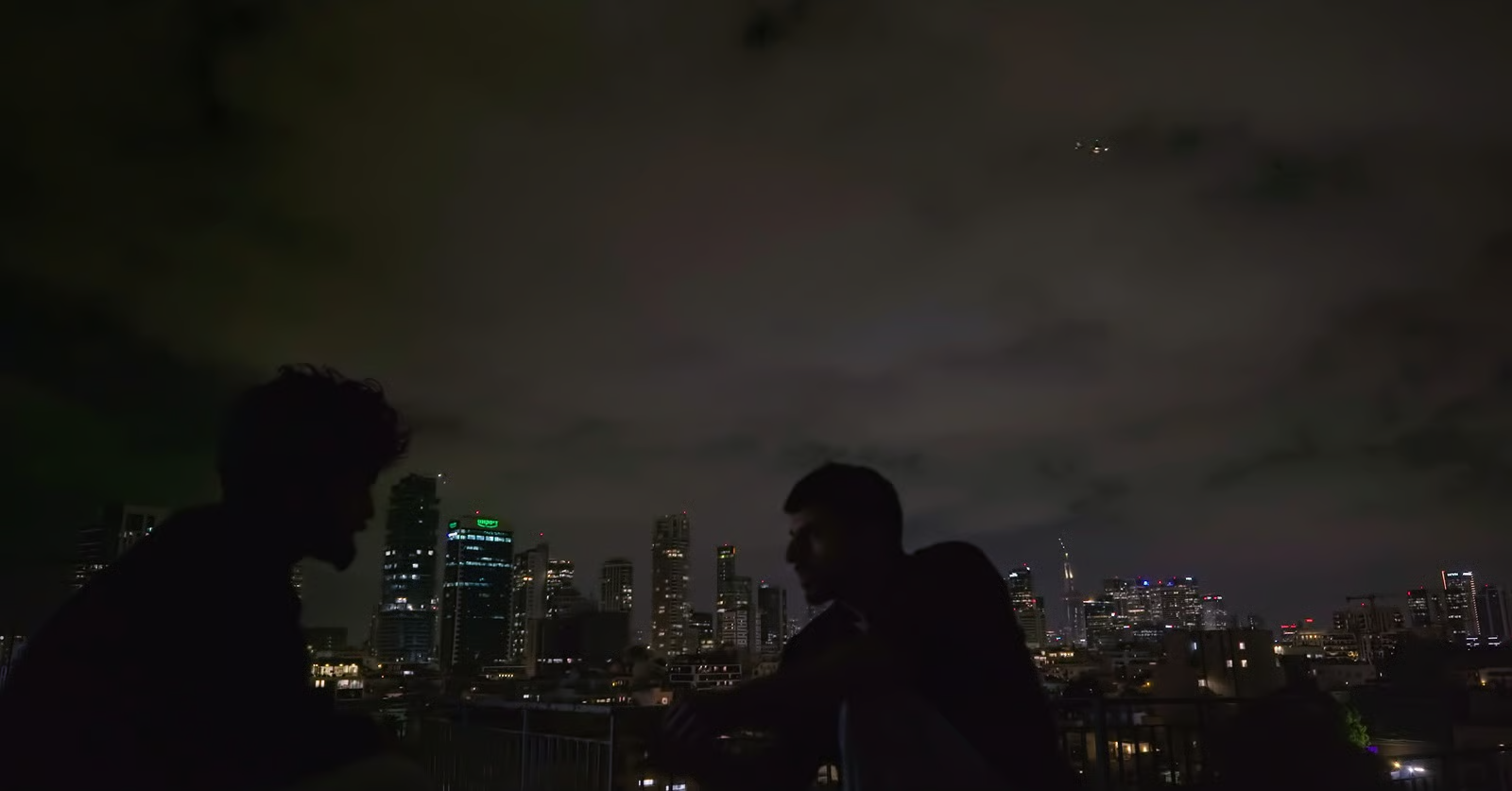
The aesthetic is minimalist, as Abraham converses with the various soldiers on the rooftops of Tel Aviv. It is never quaint or silent enough – the power goes out, airplanes fly eerily close to them, alarm sirens ring constantly, and missiles fly over them. It’s The Zone of Interest again. It’s hard not to be absorbed by the way in which Abraham and Szor film Tel Aviv away from the idealized imagery of state-sanctioned Israeli cinema and television, and showcase the day-to-day noise the population is dealt with, as Benjamin Netanyahu repeats on television that the operations being performed in Gaza are necessary to “eradicate Hamas.”
Perhaps NAZA doesn’t tell anything new, but does it really matter when a movie has never openly confronted the State of Israel’s military operations the way this does? By far, the most harrowing conversation occurs when Abraham point-blank asks a soldier if he thinks what is happening in Gaza is a genocide. One has to understand that many prior subjects discussed how killing Palestinians is akin to a video game – the military makes the exercise “fun” through an Artificial Intelligence software that remotely performs strikes. None of the soldiers will ever see the extent of their own actions until they are confronted by what has transpired during a stomach-churning final montage of Gaza in October and November 2023.
That’s why, when Abraham asks the question that Israeli officials are bending over backward in attempting to justify that none of what they’re doing constitutes a genocide (even if world-renowned experts say otherwise), the soldier doesn’t hesitate and says “Yes.” Abraham then goes one step further and asks, “Are you saying you participated in a genocide?” to which the soldier replies, “Yes. We intended to kill those children.” Nothing else needs to be said. The rest of the documentary left the entire crowd at the Cinéma du Musée in stone-cold silence, reckoning with the words and images that the filmmakers present, including an archival interview with Netanyahu, who explains his own definition of terrorism from his book, Terrorism: How the West Can Win.
In that 1986 interview, the current Israeli Prime Minister says, “My definition of terrorism is the systematic and deliberate attack – murder, maiming and menacing – of innocents and civilians, for political goals.” No clip will ever be more damning for Bibi’s legacy than this one. No movie will ever be more damning for Israel’s propaganda machine than NAZA. And no documentary this year is more important than this harrowing, but necessary work of bearing witness and remembering who aided and abetted these atrocities when innocent people are still dying, and many are still staying silent at what’s unfolding in front of their very eyes…