‘The Last House’ Review: Louis Leterrier Crafts an Homage to Shyamalan in Effective Thriller
While not without its flaws, The Last House, a film that seemingly draws inspiration from M. Night Shyamalan’s early days, shouldn’t be dismissed, especially given how aesthetically and thematically sturdy it is.
No one told me that Louis Leterrier’s ‘The Last House’ takes a massive page out of M. Night Shyamalan. In fact, if you told me the director who gave us Signs and Lady in the Water actually helmed it instead of Leterrier, I’d believe you. The film is so Shyamalan-coded from top to bottom that one wonders why it’s getting dismissed like that. Such an aesthetically and thematically rich product, distributed by Netflix, is rare, but Leterrier’s innate skills as a genre artist shine through in a movie that constantly surprises us, even if its allegory might feel somewhat problematic.
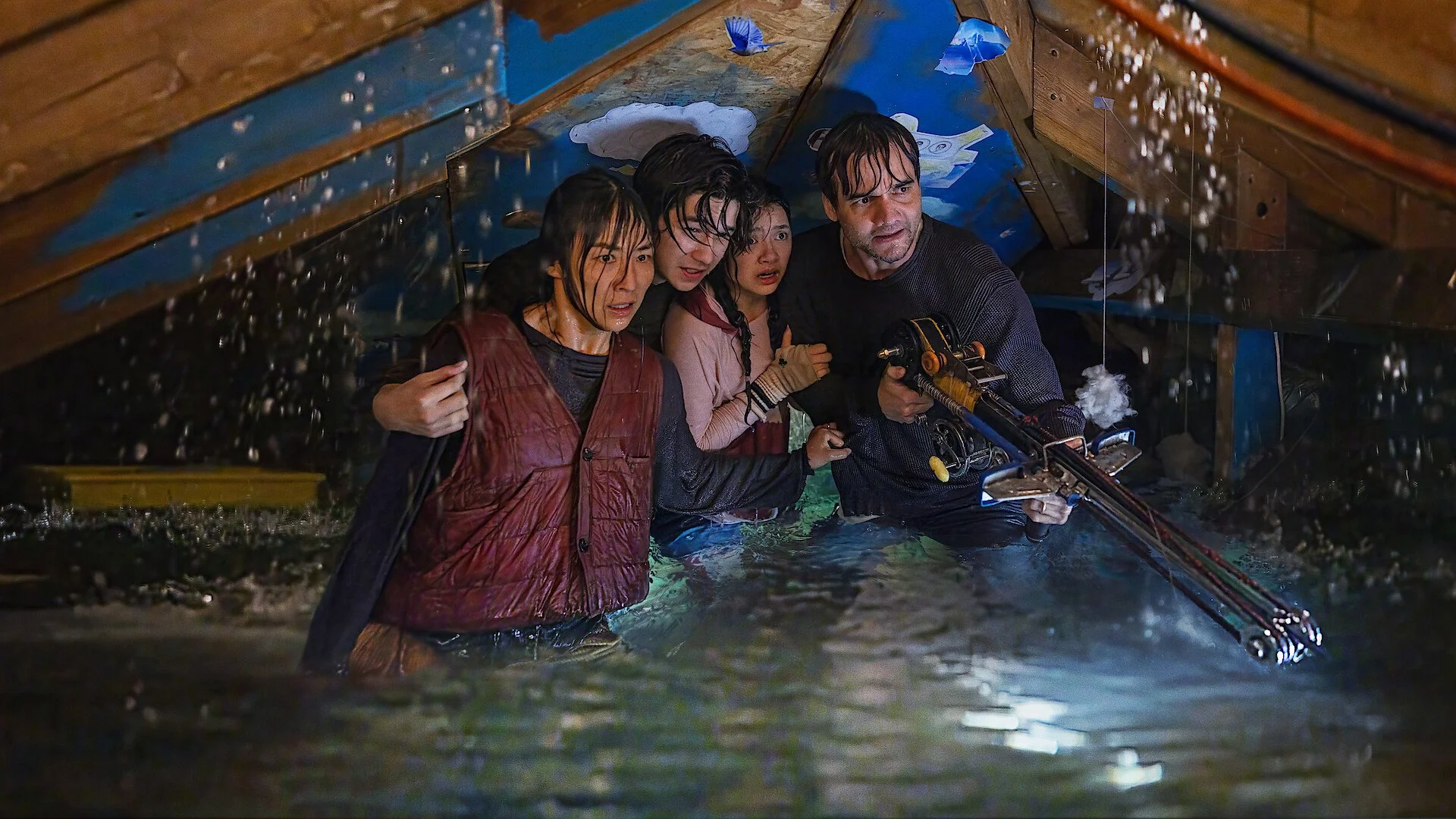
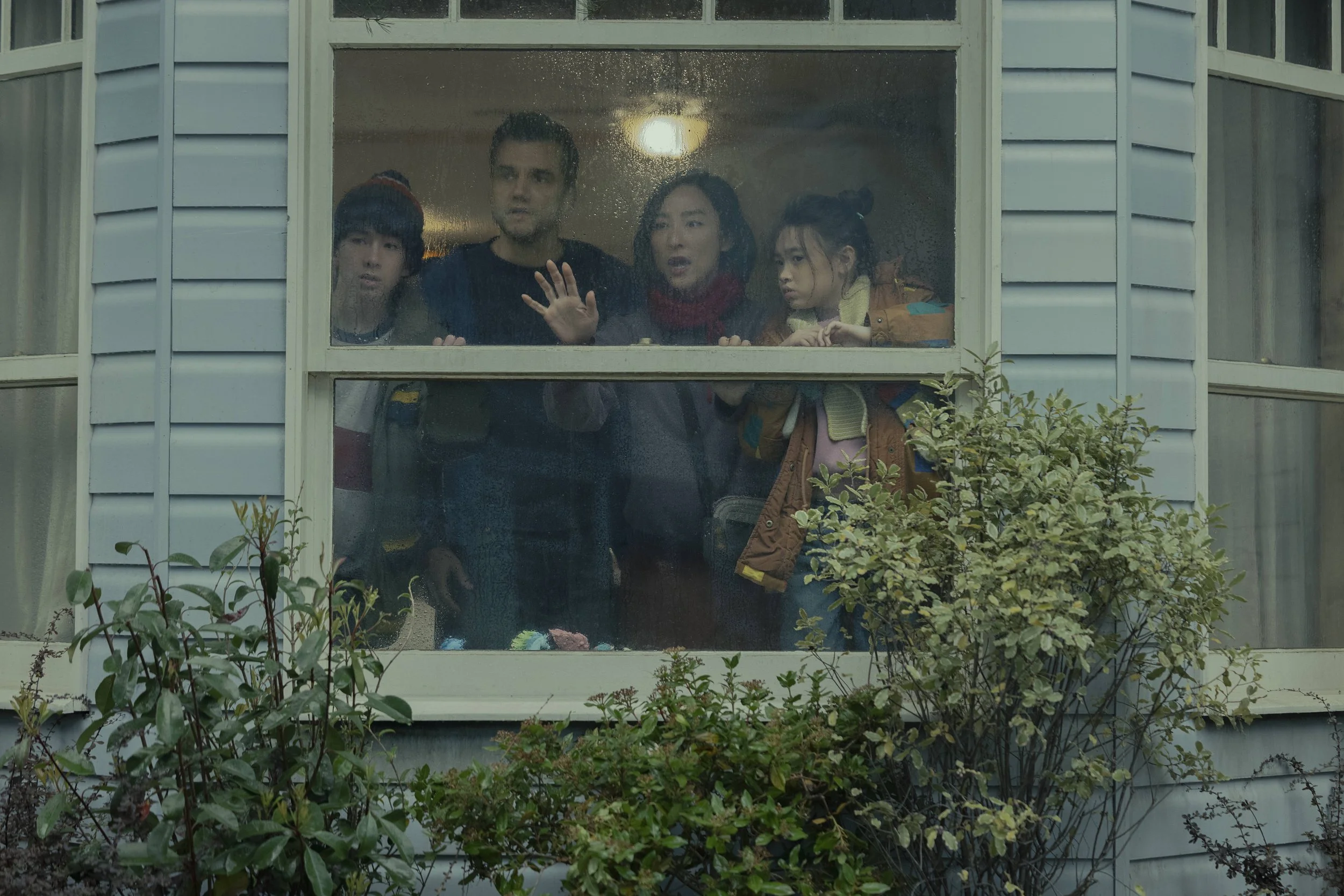
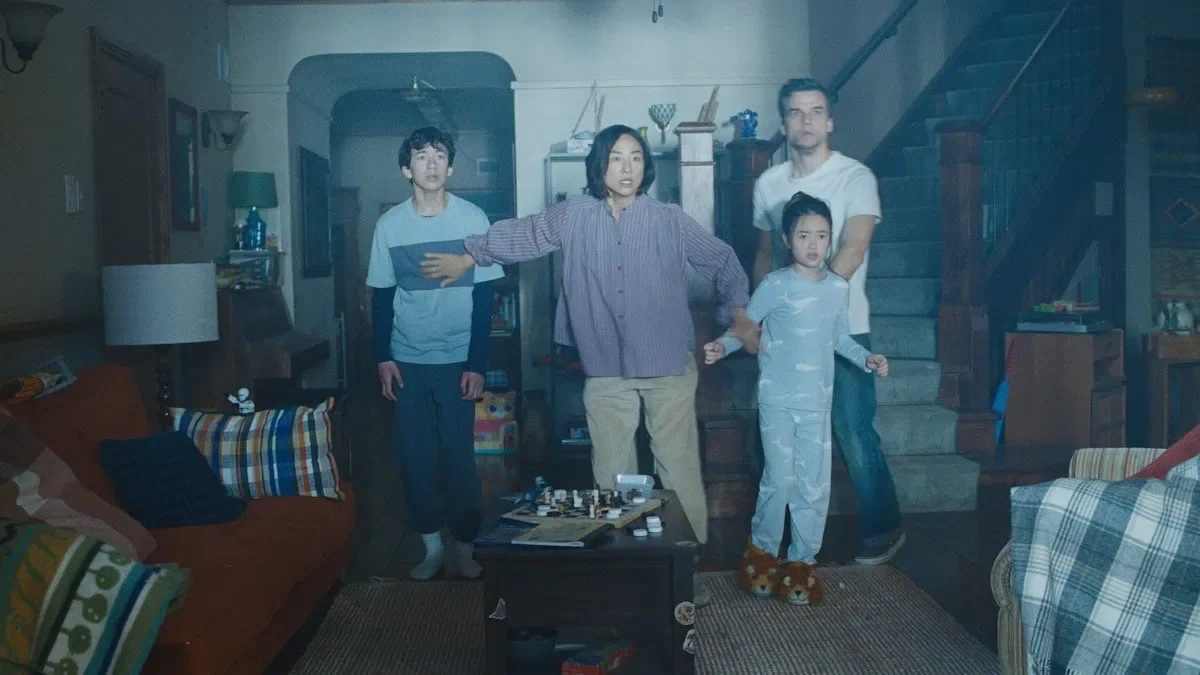
It won’t take long for you to realize that Leterrier and screenwriter Matthew Robinson are discussing the COVID-19 pandemic as families in a quaint neighborhood are suddenly locked into their homes, with no possible way out. No one knows what’s going on, or what phenomenon is actually causing this. What they do know is that there’s something outside that needs to be avoided at all costs. In this situation, we follow the Delgado family, comprising husband and wife Jason (Wagner Moura) and Ann (Greta Lee), and their children Ruth (Riley Chung & Emma Ho) and Graham (Noah Alexander Sosnowski & Gabriel Chung), as they attempt to make sense of a situation that defies all forms of logic.
For the film’s first hour, Leterrier and cinematographer Pål Ulvik Rokseth enrapture us in a visual language that responds, literally and figuratively, to the family’s sense of isolation. The 1.78:1 aspect ratio slowly shrinks down as The Last House progresses, to represent the mental (and physical) challenges they face as days turn into months, and months turn into years, with no way out of their current predicament, despite the constant sacrifices they make to ensure survival (such as “chimney fishing” for any mammal that comes in their wake, to eat them). This is as much a psychological horror as a literal one, especially after we learn what is lurking in their neighborhood.
For many, such a reveal might make or break their appreciation of the work, as it would in any respectable Shyamalan film. For myself, there are elements that definitely needed more fleshing out, but the core mythology at the center of the film isn’t uninteresting. It also helps that Leterrier knows how to craft legible and thrilling action, with his roving camera being a particular aesthetic highlight in an era that has grown less interested in kineticism. Fresh out of helming Fast X (as a director for hire after Justin Lin left the project, mind you), Leterrier applies what he’s learned in those big-budget constraints inside a confined space and continually finds new angles to make the central threat at the heart of The Last House terrifying.
Perhaps the CGI needed an additional coat of paint, but that doesn’t make the film's visual elements any less impactful. The core performances at the heart of the picture, through Greta Lee and Wagner Moura’s fractured couple, are also important in conveying their sense of isolation and despair. Lee holds her own in an action sequence that would’ve gone gangbusters in an IMAX temple, while Moura’s progressive dissociation acts as a genuinely emotive anchor to the film’s main throughline. The child performances by Riley Chung and Noah Alexander Sosnowski are also excellent, but their older versions, as the movie progresses, leave much to be desired.
In fact, once The Last House jumps forward in time to show how the Delgados have used this apocalyptic situation to survive, the movie also loses momentum. Ideas that were introduced in the film’s first half are barely explored, and the movie frequently jumps the shark to go from one improbable situation to the next. Leterrier also includes images within Ann’s psyche that act as bridges from her dreams to the harsh nightmares of reality, but they never recur in the movie. They appear once and are never mentioned again, almost as if the thematic journey of The Last House doesn’t much matter. Without spoiling anything specific, the climax's resolution is also baffling, especially given how the family attempts to trap whatever entity is outside their household, Home Alone-style. All of this work…for this? It’s almost insulting if it weren’t for one of the cleverest aspect ratio shifts seen since the “valve open” in Christopher McQuarrie’s Mission: Impossible – The Final Reckoning.
Still, there’s much to like here, far too much to dismiss this picture outright. Leterrier has been doing solid work for a long time now, and while he’ll never get his flowers as genre auteur, his oeuvre is invigorating and exciting enough to be studied seriously. The film might not reach the heights of his best film, Unleashed, but it’s nowhere near the disaster of something like Clash of the Titans or The Brothers Grimsby. Those were stinkers. The latter in particular is unwatchable. The Last House has enough to make this one of Netflix’s better productions, and I refuse to hear otherwise.