
‘Sheep in the Box’ Review: Hirokazu Kore-eda’s Most Forgettable Effort
Despite an incredible lead performance from Haruka Ayase, Hirokazu Kore-eda struggles to translate many ideas on screen in ‘Sheep in the Box’, making it a massive misstep for the prolific Japanese auteur.

Hirokazu Kore-eda is no stranger to prestige, having won the Palme d’Or in 2018 for Shoplifters. His contemplative body of work constantly evolves into thought-provoking and gut-wrenching dramas that showcase the most profoundly human characters you will meet on the silver screen. It’s thus no surprise that, for his grand return at the Croisette in 2026, he chose to tackle the subject of A.I. through a story that seems to tread on ground that other prolific auteurs have talked about, in ‘Sheep in the Box’. The mixed-to-negative reception the movie received at Cannes essentially primed this critic that it would be one of my favorite Kore-eda movies (a filmmaker whose style I have massive difficulty gravitating towards), but I have to concede here: the cold reactions are entirely correct.
Kore-eda doesn’t really reinvent a story that has been done countless times already, most famously in Steven Spielberg’s A.I. Artificial Intelligence, but at least he has Haruka Ayase give what will likely be remembered as the best performance of her career. Portraying Otome Komoto, a mother who still hurts from the devastating loss of her son, Kakeru (Rimu Kuwaki), she immediately jumps at the opportunity of becoming a test family for a humanoid robot that looks and sounds just like the child she lost a few years ago. Her husband, Kensuke (Daigo Yamamoto), isn’t enthused at such an idea, but reluctantly accepts.
When “Kakeru” returns home, Kensuke tells it not to call him “papa,” but “mister,” setting some distance from his real son to the robot one. And for the first hour or so, Kore-eda focuses solely on the parents and their reactions to something they don’t fully understand. It’s the best part of the movie, because there’s a precision in Kore-eda’s aesthetic that allows us to understand the innermost thoughts of his characters without spelling it out to the audience. The way that his camera focuses on their sullen faces and lingers on their shifting expressions is a defining trait of his work, but it has never been more effective than in Ayase’s hands.
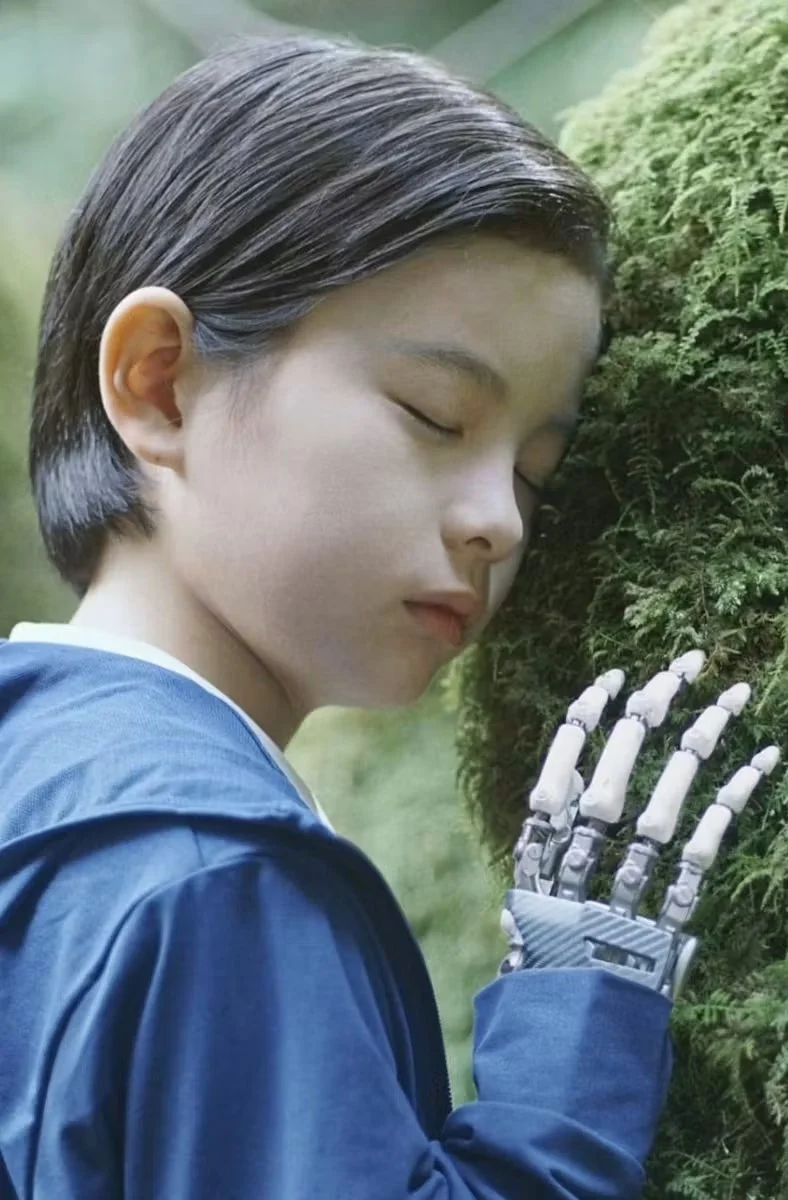
Her performance is so unbelievable one wishes she’d be in a better film than this one. Portraying any grief-stricken character is difficult, but the way in which she balances Otome’s joy – and painful sadness – will leave you breathless. It’s a profoundly affecting (and deeply human) turn that slowly devastates as Kore-eda reveals micro-expressions that hide immense, unprocessed grief that may never be fully addressed by pretending Kakeru is still here with her. A contrast is thus highlighted in the way Otome looks at her fake son (she wants her son back and is happy at the sight of a humanoid who looks and sounds exactly like him) and Kensuke, who keeps his distance for the bulk of the movie until a pivotal peak turn.
We understand that both characters process their grief differently, and that the bulk of the film will be about peeling back their own vulnerabilities and insecurities, as exemplified by the stark conversations they have with the humanoid. It is the movie’s most interesting thematic thread because Kore-eda is engaged in the characters he draws and their reactions to something they don’t fully understand but want to learn more about, as they attempt to process the insurmountable.
Unfortunately, it’s also where the movie begins to sag and fails to develop anything it presents. Instead of continuing to flesh out both Otome and Kensuke’s grief, Kore-eda switches gears and haphazardly introduces a commentary on the misuse of AI by presenting a group of humanoid children that were “resurrected” only to be abused by their parents. The intention is there, but the execution is so clumsy that it almost feels like such a thread belongs in a completely different movie than the one we were watching. It comes out of nowhere and barely gets a chance to have an emotional impact.
Because of this, Sheep in the Box’s main narrative thread stops growing and begins to have difficulty finding its footing, as it runs around in circles until it reaches an emotional conclusion that feels cheap and manipulative, words that have never been uttered in anyone’s description of Kore-eda’s oeuvre. I mean, the guy knows how to make some of the most devastating and emotionally powerful films you’ll see (Maborosi, Still Walking, Monster) while conveying a stark naturalism that makes its more difficult scenes strikingly realistic.
As incredible as Ayase is, the concluding section of Sheep in the Box doesn’t feel earned for anyone, and results in a disappointing venture from a filmmaker who has given so much but seems now struggling to reinvent himself in a world that is moving away from Kore-eda’s oeuvre. Its commentary on the dangers of AI is dated and uninteresting, which is a shame considering how perfectly calibrated its central performance is. Here’s hoping Kore-eda bounces back much sooner than later, which he will have the opportunity to do so with his readaptation of Tatsuki Fujimoto’s Look Back, set to once again premiere at a major film festival. If the animated film is any indication, tissues might be necessary…