
'Marty Supreme' Review: A Stunning, Sprawling Winner
Josh safdie’s solo debut is equal parts ambitious and assured.
Greatness has always been a loaded topic, especially in a world as subjective as cinema. In our ever-homogenizing media landscape, it often feels like great art and those who wish to create it are on the back foot. Too often, we see that creating great art just isn’t enough to be deemed a successful artist, or a success in general, due to that greatness being determined, and permitted by the forces of capital. Enter director Josh Safdie’s latest, Marty Supreme, a film that feels very concerned with these ideas, and on so many levels.
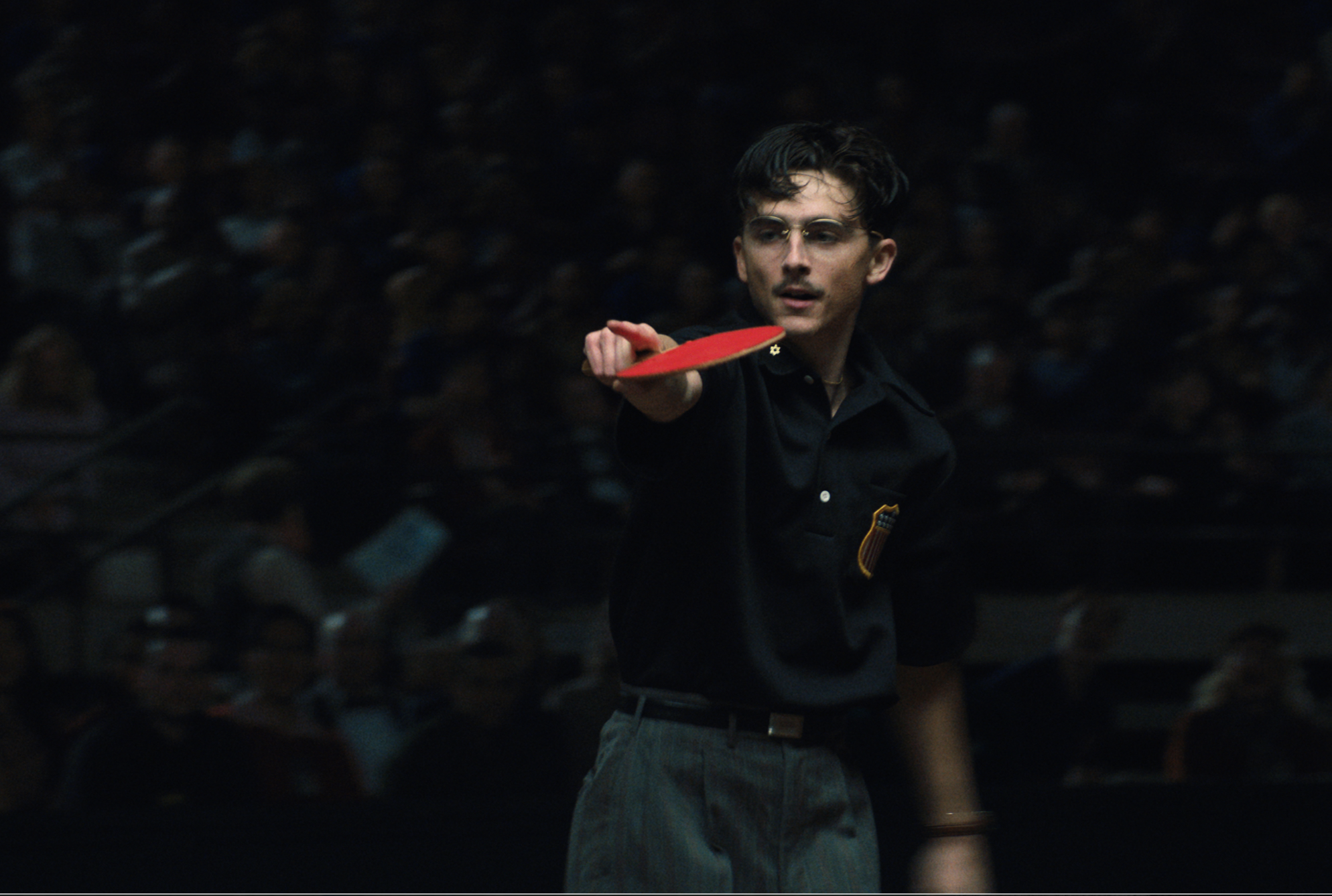
Marty Supreme is a sprawling 1950’s epic that blends the sports film with the hustler film, with all of the kinetic chaos that has become synonymous with the Safdie brand. This brief attempt at a logline can’t begin to describe how many different areas of narrative and tone that Safdie and longtime co-writer Ronald Bronstein explore with the film, swinging big at every turn, to varying results, but it’s genuinely hard not to commend each one. The film follows Marty Mauser (Timothée Chalamet), a part-time shoe salesman yearning to prove himself as the greatest ping-pong player in the world, who must contend with a series of ongoing obstacles, in the realms of entertainment, exhibition, crime, and personal dramas on his road to greatness. The comparisons to Josh Safdie and Ronald Bronstein’s last collaboration, Uncut Gems, will be inevitable, but it must be said that Marty Supreme is a different beast entirely. The film is much less singular and concise, with bigger, globe-trotting ambitions, losing none of the tension.
Any conversations around the film will in large part center Timothée Chalamet, and rightfully so. Chalamet’s emergence as a bonafide movie star is nothing new, having already opened many commercially and critically successful films as a lead, and has long been an awards darling. Anyone who’s reading this knows as much. However, both Chalamet both on and off-screen with Marty Supreme, is sending the audience a new message, that he truly wants to be one of the greats of the craft, giving ample reason to believe that he’ll get there sooner rather than later.

As Marty Mauser, Chalamet taps into a classical underdog, but plays this archetype in such a multifaceted way that’s hard to write off as a ‘baity,’ competition-film performance that many postere young actors chase. Chalamet can be genuinely commanding in the more intense competition sequences, fully locked in to a daring physicality, come off as a selfish prick who neglects his family and friends, and even channels his boyish charm when needed. Chalamet is going big, it never feels like he’s doing so in service of his own agendas and distracting from the film, but rather serving and driving Mauser's story. He’s breaking new ground in his already impressive career, and it feels like such an impassioned, and welcomed announcement. Chalamet himself has made his athletic mentality to his acting career well-known, and his excellence in a sport/competition film like Marty Supreme further validates his personal thesis, and giving us a reason to believe as well.
Conversely, Safdie and Bronstein find themselves in new territory, as Marty Supreme is a period piece, with their prior works inhabiting modern New York City, woven in the hectic fabric of the city that never sleeps. The legendary production designer Jack Fisk was enlisted, someone with an extensively acclaimed history of creating period sets on other epics such as There Will Be Blood. The 1950’s New York of Marty Supreme is never as much of a focus, as it may have been in the likes of say Heaven Knows What, and ultimately, the environment represents a hamper to Marty’s global aspirations, reflected by its use for interior scenes where Marty is confined to areas he never wants to be long term, such as the shoe shop he is posited to run, or the apartments of both his mother Rebecca (Fran Drescher), or on-and-off girlfriend Rachel Mizler (Odessa A’zion). Perhaps the biggest compliment (though it may sound backhanded) to the world and atmosphere of Marty Supreme is that despite the tangible period setting, the film feels tremendously salient and contemporary. Safdie and Bronstein seldom revel in period frivolities, and keep the story engaging, prioritizing the main arc of Marty’s rocky road to greatness above all else.

Mauser’s journey takes him to London and Japan for ping-pong tournaments, and while it may sound like hyperbole at first, Josh Safdie is able to make the game of ping pong exhilarating. With both long-in camera takes showcasing Chalamet’s commitment to Mauser and his ping pong mastery, and quicker, more intense editing, Safdie and cinematographer Darius Khondji go deep into their bag, while echoing the vibe and rhythm of classic sports films. Likewise, longtime Safdie composer Daniel Lopatin delivers an unforgettable score, concocting a blend of classical, rousing competition film score, 80’s inspired-synth, and 80’s needle drops as well.
While abroad, Mauser becomes acquainted with semi-retired actress Kay Stone (Gwyneth Paltrow, in her first acting role since 2019), and her wealthy businessman husband Milton Rockwell (Kevin O’Leary, as sleazy and nasty as ever). Marty and Kay’s relationship blossoms into a full-fledged affair, and one that becomes a temporary source of levity for the film, letting Paltrow use her old magic and gliding off of it, letting Mauser and the story in tandem become a bit more comedic. However, Milton Rockwell more or less becomes the story’s main antagonist, and the ‘out of the box’ casting of real life business tyrant O’Leary pays off in spades, going so far as to embody and even proclaim Faustian qualities. While Marty contends with the rigid heads of the Table Tennis Association, he banks on Rockwell for financial sponsorship for his quest of greatness. The relationship between Mauser and Rockwell is so tense it could be cut with a knife, but too tense to ever cut from an editing standpoint. It’s this relationship that so aptly sums up one of the film’s theses on greatness, and how the monetary interests of such businessmen can be heartbreaking gatekeepers to greatness itself.

Back stateside, Marty finds himself getting into more classical Safdie hijinks with his friend Wally, (Tyler Okonma) and girlfriend Rachel, in the natures of debt and personal affairs. Compared to the rest of the film, these portions are more frustrating, and intentionally so, with more complicated and stress-inducing situations at play. Nonetheless, A’Zion and newcomer Okonma bring their A-games, adapting to these more chaotic, volatile situations.
At its core, Marty Supreme is just a marvel. For a film so concerned with greatness, it lives up to its aspirations, and then some, packing bold swings galore, and even if their hit ratio may vary, they all still hit in some way. Though the film will rightly be lauded for its explosiveness and kineticism, it still ostensibly emerges as Josh Safdie’s thoughtful and consious film. Make no mistake, the film still works as an explosive thrill ride, filled with adrenaline inducing set-pieces and a series of successful stunt castings, but that’s not all there is to it. As much as the film can be read as a story about artistic or athletic greatness, it does so in such a carefully constructed way, one that doesn’t gloss over the unfavourable lengths Mauser must go to on the road to greatness. As bold as the film is formatively and visually, (going so far as to directly homage Spike Lee’s controversial She Hate Me), it does not lack this boldness in narrative. It’s also unafraid to challenge, and even oppose Marty’s idea of greatness at times, with an underlying current of its toll on both the financial and emotional aspects of Mauser’s life. Its unconventional veers into more uncomfortable, interrogative territory could easily have passed as edgy or unneeded, but are handled with such a deftness and radius of relevance to the larger thematic undertakings.
All of this succeeds due to how well Safdie is able to use several different pastiches, and effortlessly blend them together into something so distinct and gripping. At once the crossroads of two major talents at the peak of their respective powers in Safdie and Chalamet, and a distinctly new kind of American epic, Marty Supreme will rightfully be showered with its fair share of superlatives, and is as good a bastion as American cinema could get for the message of dreaming big.