‘The Wizard of the Kremlin’ Review: A Major Bag Fumble for Olivier Assayas
Despite a solid cast and assured photography, Olivier Assayas fails to meet the moment with The Wizard of the Kremlin, delivering a complete nothingburger that has no idea what it wants to say about the figures it presents.

Courtesy of Game Theory Films
After muted premieres at the Venice and Toronto Film Festivals, Olivier Assayas went back to the drawing room and cut twenty minutes out of his 156-minute The Wizard of the Kremlin to improve its pacing. Sadly, there’s no improving a painfully languishing historical epic that has nothing of interest to say about any of its characters or the historical situation in which the film is set. Many will have strong opinions on Assayas’ prior works, and I can’t say that all of his features worked for me. However, they are never boring. The Wizard of the Kremlin feels like a major tonal whiplash because it’s the first in his ever-growing corpus that is dreadfully dull.
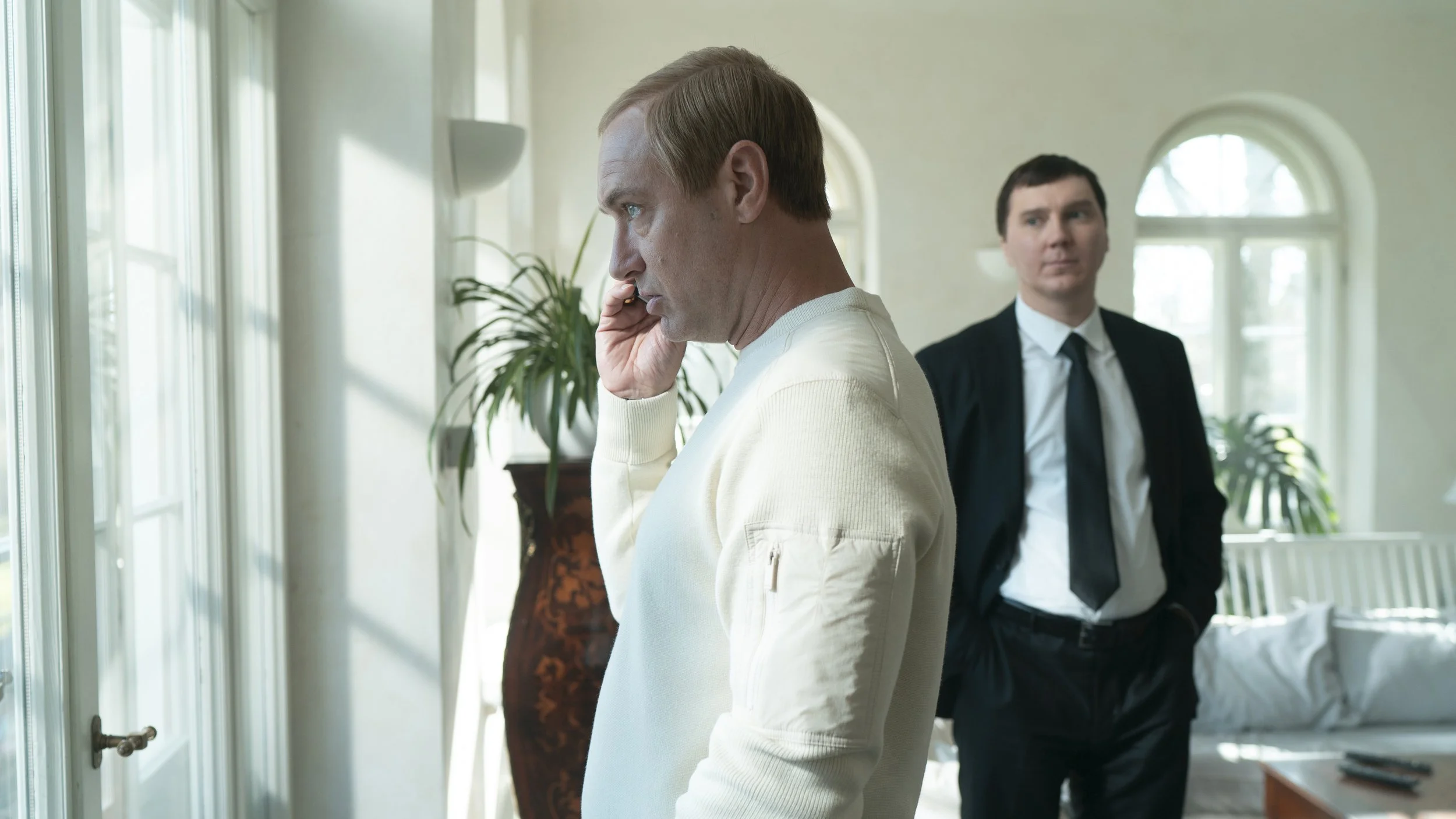
You immediately get a sense that this film will amount to very little as soon as it begins, introducing us to journalist Laurence Rowland (Jeffrey Wright), who arrives in Moscow to meet elusive spin doctor Vadim Baranov (Paul Dano). From there, the character inspired by the figure of Vladislav Surkov recounts his life in chronological order, starting with the conflicted relationship he has with his father, his work as a playwright and artist, television producer, and eventual meeting with KGB Agent Vladimir Putin (Jude Law), who will eventually become Russia’s President.
Baranov becomes a crucial figure within Putin’s rise to power, especially when then-president Boris Yeltsin (George Sogis) is experiencing health issues that force him out of the picture, appointing Putin as his interim successor before an election is held. Assayas and co-writer Emmanuel Carrière now have the golden opportunity to examine the rot at the heart of Putin’s regime and to offer a stark warning on how democracies crumble when they begin to silence his critics, and to know how and when to spin events occurring within the country itself and in Ukraine.

Courtesy of Game Theory Films
Unfortunately, Assayas seems ill-equipped to discuss this, or anything else, in this truncated version of his original intent that still runs too long and remains punishingly tedious. Were it not for relatively textured photography from cinematographer Yorick Le Saux, one of the best photographers working today, and a compelling performance from Jeffrey Wright, this entire thing would be a complete waste. In fact, there simply isn’t enough of Wright’s journalistic perspective, which provides the only form of contextualization (through a thoughtful voiceover narration), eager to discuss the rise and fall of the person he wants to profile before we get a chance to meet him.
However, as soon as Vadim appears on screen, everything else is told through his perspective, and the movie quickly loses its grip. The narration wants to fill in the gap as the film moves through time, but it doesn’t know what to focus on. Should it recreate pivotal moments of Putin’s reign, through the eyes of its closest government official, or simply go through the motions and hope the audience grasps something out of a movie that doesn’t have much interest in the figures it depicts? Assayas seems completely disinterested in what he’s showing, which is strange, considering how engaged the filmmaker has always been in his movies and beyond. It presents a series of events with little to no consequence or urgency, with three great actors giving pitifully embarrassing performances, people I always hold in high regard when working with some of the world’s most acclaimed filmmakers.
Dano might be the least affected of the trio of performers who lead this drama, only because his character has the most de facto depth, since we spend the most time with him. Law, on the other hand, never knows how to register Putin. Was he truly unable to pull off a Russian accent, which essentially portrayed him in the same vein as most of his well-known characters, with a British accent? Either way, there was a golden opportunity for him to elevate the despotic figure’s theatrics in the same vein as Sebastian Stan’s Oscar-nominated turn as Donald J. Trump in Ali Abbasi’s The Apprentice, which, in contrast to Assayas’ film, actually has something to say about the figure it depicts.
Assayas seems afraid to even take a meaningful stance on his controversial figures, and treats the film’s sole female character, Ksenia (Alicia Vikander), as a one-note object with very little agency. Vikander gave her best-ever performance in Assayas’ reinterpretation of his own Irma Vep (still his masterpiece, with the greatest turn you will see from an actress in a film in Maggie Cheung), which is why it’s so baffling that every note she hits as Ksenia is the wrong one, but it’s probably also because there’s little in the screenplay that makes her fully three-dimensional.
Courtesy of Game Theory Films
As a result, the movie is an aggressively disappointing affair in search of its own identity and posits Assayas as a figure who has completely lost his authorial voice. The Wizard of the Kremlin is a vacuous, quasi-historical lesson that presents itself as an urgent warning against fascism and state propaganda but has no idea what it should warn audiences of. The Apprentice knew what to do with Donald Trump and made the message legible as his meteoric rise to fame (before power) began.
In The Wizard of the Kremlin, we are witnesses to Putin’s rise, but it’s treated with such matter-of-fact indifference that we have no idea what it ultimately means in the context of the film. Of course, Putin’s regime has been oppressive in ways that few imagined would occur at the scale it ultimately did when he became President. There were warnings that putting such a man in power would be dangerous, but few listened. Now, Russians – and the world – are paying the price.
You can watch Julia Loktev’s devastating My Undesirable Friends: Part I – Last Air in Moscow to get a sense of what is currently unfolding in Russia and the grip that Putin has over all aspects of media, rather than this meandering slog that feels much longer than a five-hour-and-twenty-four-minute documentary. At least Assayas had the decency to shave off twenty minutes from this interminable drama so we can get a bit more out of our lives than wasting it on this worthless affair that was never worthy of the world’s most prestigious film festivals…