
‘Late Fame’ Review: A Character Study of Inherent Sadness
Willem Dafoe and Greta Lee give two of the year’s most moving and profoundly tragic performances in Kent Jones’ Late Fame.
Should you give up on your dreams for a stable, safe life? What happens if you do so and suddenly get “rediscovered” almost fifty years after you “peaked,” decided to turn a new page in your life, and moved on from what made you the happiest? These are the central questions at the heart of Kent Jones’ Late Fame, a profoundly tragic character study that wrestles with ideas that likely ruminate in most of our minds.

I’ll be honest: this “film criticism” endeavor isn’t paying the bills, despite being part of major organizations and having accomplished so much in such a short time. Finding employment in this volatile era is difficult, while others are thriving by building their own brand. There are many times when I think about giving it all up, especially as major events unfold and nothing seems to move the needle. But if I do this, what will happen to the most creative part of myself, the one that enjoys laying it all out on paper and talking about film as an art form?
Poet Ed Saxberger (Willem Dafoe) gave up his efforts to break into the New York art scene long ago, even though he hung out with figures such as Allen Ginsberg, whose presence in the scene was highly influential. He’s been working in a dingy post office for the past thirty years. His life is boring, but he at least gets by and hangs out with a tight-knit community of friends at the bar every night to play a round of pool. He’s a man of routine who’s completely removed from who he was as a freewheeling poet who wrote an undiscovered collection titled Way Past Go.
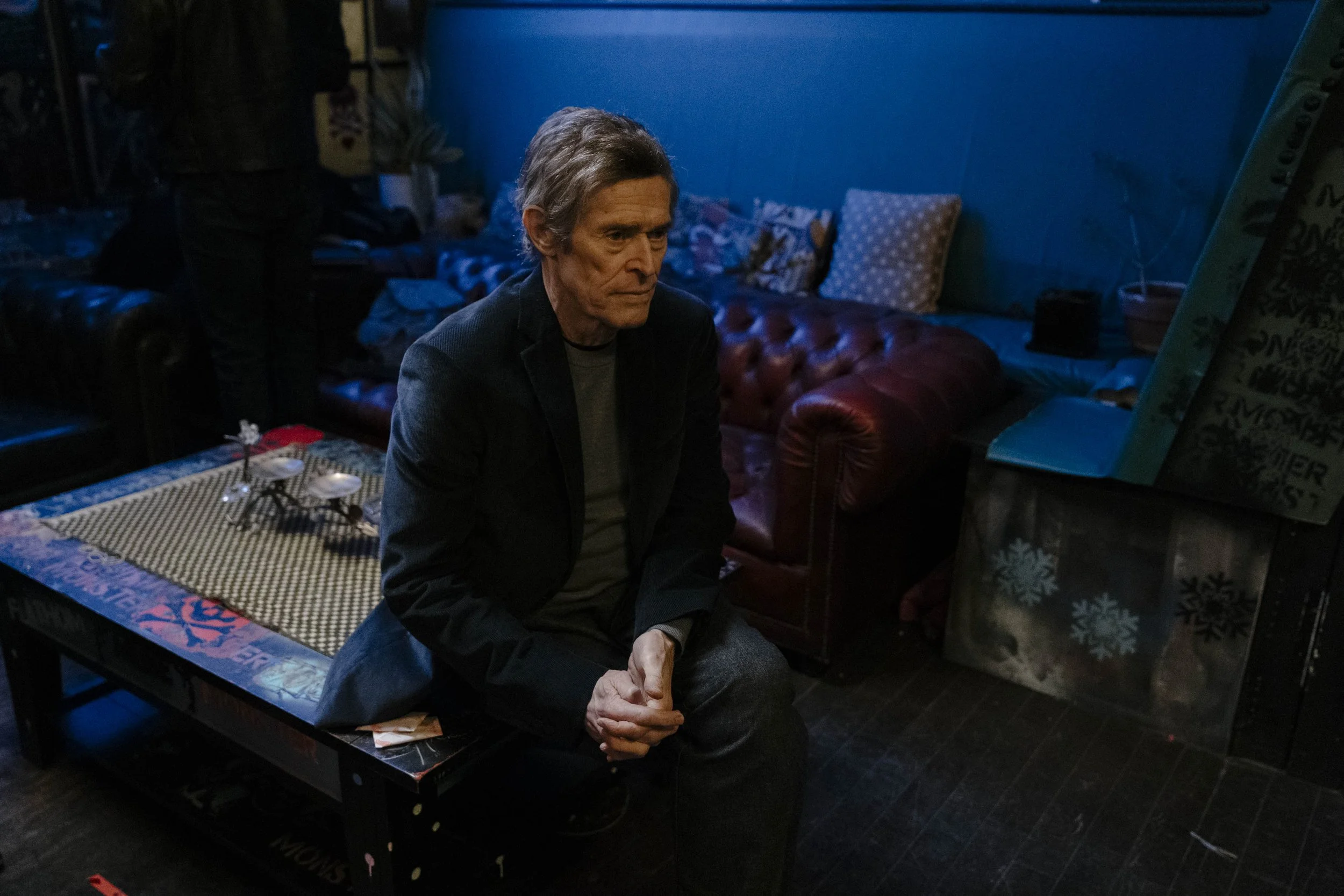
That is, until an aspiring poet named Myers (Edmund Donovan) shows up at his apartment unannounced, stating that he read Saxberger’s collection of poems and would be honored if he joined a collective of authors dubbed “The Enthusiasm Society.” At first, Ed can’t believe someone other than him read Way Past Go and is initially flattered to entertain his small fanbase. However, he will begin to wrestle with thoughts he hasn’t fully reckoned with for a long time, especially upon meeting Gloria (Greta Lee), the only female member of the society, whose eyes hide a profound sadness that won’t be extinguished anytime soon.
The bulk of Late Fame occurs as both characters attempt to hide their inner sadness. Ed can do so quite easily, especially among his newfound friends, but Gloria’s eyes always betray her showy demeanor. Paired, Dafoe and Lee are incredible, with their respective pain slowly healing as they find purpose in life again. Their performances are only this good because of Samy Burch’s incredibly textured screenplay, on a generational run of being one of the most exciting screenwriters of this decade, especially following the work she did to add emotional complexity to age-old archetypal characters in Coyote vs. Acme.
Her script is so full of humanity that, even when Late Fame threatens to sag and become conventional, its actors can modulate complex micro-expressions on their faces that give us a general idea of who these people are beyond their façades. Ed finds joy again when hanging out with Myers, but he can’t muster up the courage to see his ailing brother one last time as his sister frequently calls him to describe his condition, waiting for his passing. He also seems afraid to share an artistic past with his best friend Arnold (Clark Johnson), who is initially curious and wants to learn about Ed’s endeavors. However, Saxberger’s reluctance to talk about it creates distance between them, even though he wants to understand the source of this artistic passion.
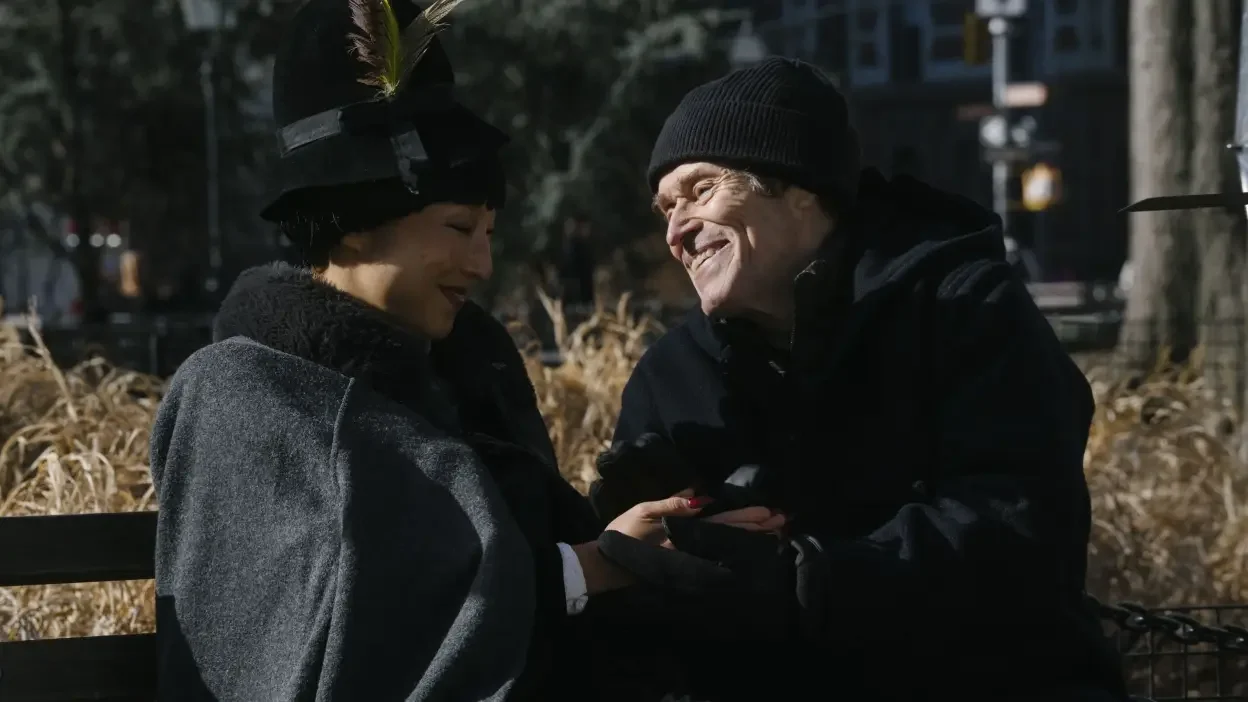
That moment of vulnerability, pride immediately met with anxiety, is the stuff that many of us creatives face in our daily lives. We believe creativity is the best form of expression for us to talk about ourselves, but once we show it to others, that bubble can be shattered. Ed wrote Way Past Go. It’s a part of him. A part he doesn’t want to fully revisit, so much so that he doesn’t really interrogate Myers’ group to ask what they particularly gravitated towards in the book itself. He doesn’t even want to read a section of it aloud during a live reading, asking Gloria to do it instead. Of course, the whole movie revolves around Ed actually reading the text, and nothing can prepare you for the way in which Dafoe plays that scene. At first, there’s an initial coldness to the way in which he reads it, almost like he doesn’t want to.
Suddenly, he begins to open up to the text, and the resulting emotional catharsis that occurs is too powerful to put into words. It’s the type of performance we’ve rarely seen from Dafoe, who has, in recent memory, played many eccentric characters™ and fewer humans like Ed Saxberger. With Late Fame, it’s almost as if he’s entered a completely different stage of his career, more contemplative and less expressive, as a way to reflect on what his time on Earth meant now that he’s reached the age of seventy. It’s a more difficult role than any of his most-known figures, because he has to represent decades of emotion distilled in ninety-four minutes so that the film’s final few devastate as much as they renew your hope that Ed’s life will get better, regardless of a minor stint in an otherwise unremarkable existence.
Ed Saxberger is content with the life he has, but at times he wonders what it would have been like to continue writing and collaborating in the arts. I can’t imagine a world without writing, which is why I continue doing it, and will likely never stop until I’m in a casket. Your creative life is as important as your professional one. Don’t ever give it up, especially in a world that doesn’t value us as humans and treats us as mindless numbers to exploit us until we physically can’t anymore. You have a purpose, and don’t let anyone tell you otherwise.